Skip to content Skip to footer

Neck Pain & Tension Headache Relief in St Albans

Hijama · Cupping · Deep Tissue · One Session, Combined

Tight neck, stiff shoulders, headaches that start at the base of your skull or behind the eyes? Most neck pain and tension headaches come from the same source. Restricted muscle and fascia in the upper back, neck, and shoulders, building up over months or years of stress, screens and poor posture.

The Difference

Most Treatments Push Down. We Lift Up.

Massage and physio compress tight muscle from above. Cupping does the opposite. It lifts and decompresses the tissue, reaching the fascial layer underneath where chronic neck tension actually lives. Combined with deep tissue work and Hijama, it addresses what other treatments miss.

From £50 Private clinic, St Albans One-to-one Specialist Hijama & cupping clinic

Is This Right For You?

If any of the below sound familiar, our Hijama-led approach is built for exactly this.

  • Tight, stiff neck that limits how far you can turn your head.
  • Headaches that start at the base of the skull, behind the eyes, or across the forehead.
  • Tension that builds through a working day at a screen and won't fully ease in the evening.
  • Shoulder and upper back tightness that massage helped briefly but didn't fix.
  • Stress-related neck pain that flares with workload and never fully goes.
  • Sleep affected by neck stiffness or you wake up with a stiff neck most mornings.

Not sure if it's right for you? Message us and we'll talk you through it.

Recommended Approach for Neck Pain

For neck pain and tension headaches, we always start with Hijama. It's the foundation of what we do, and the strongest single treatment for tension that keeps coming back.

Below is the path we typically recommend. We'll guide you on the right level during your consultation, but here's where most clients land:

Start Here
1

Signature Hijama

Up to 10 cups across the upper back, shoulders, neck and Sunnah points. Foundation treatment, full assessment included.

FROM £70
2

Cupping Massage with Hijama

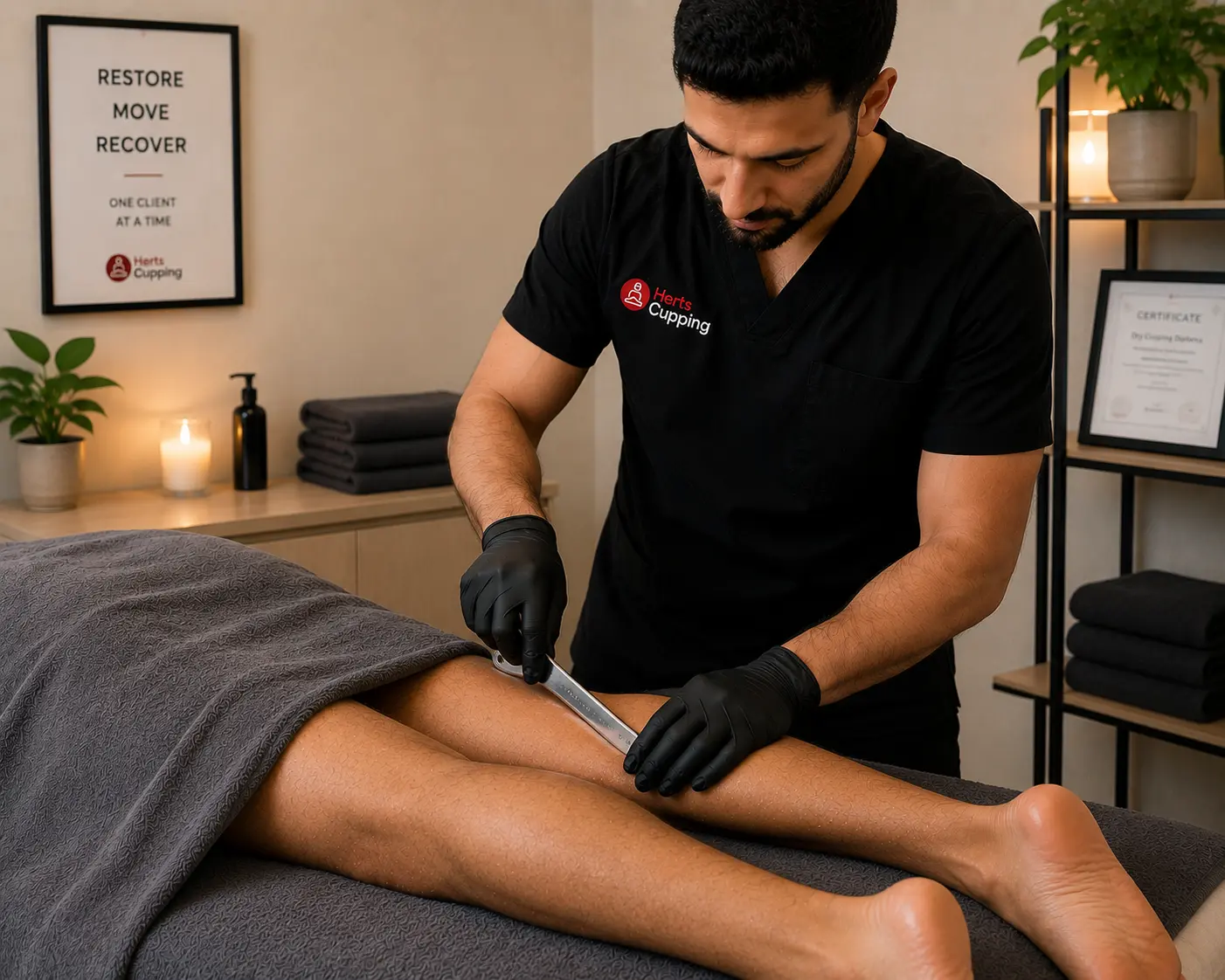
Deeper combined session. Adds IASTM muscle scraping along the upper traps, sub-occipital muscles, and shoulders. For chronic neck tension.

FROM £95
3

Full Body Cupping Massage with Hijama

90-minute extended session. Covers neck, shoulders, full upper back, and lower back. For multi-area tension and tension headaches with wider patterns.

FROM £135

Why We Always Recommend Starting with Hijama

Hijama (wet cupping) is the most effective form of cupping for chronic neck tension and tension headaches. Dry cupping decompresses the tissue. Hijama goes further by drawing out small amounts of stagnant blood through tiny superficial incisions, releasing pressure that's been built up in the muscle and fascia for months or years.

It's also the cupping treatment with the strongest backing in the Sunnah and 1,400 years of practice in Islamic medicine. The Prophet ﷺ said: "Indeed, the best of remedies you have is cupping (Hijama)."

For neck pain and headaches that keep returning, Hijama is what we recommend, and what most of our clients find makes the genuine difference. Dry cupping is available if Hijama isn't right for you, but it's the lighter option.

Why Clients Choose Us

Specialist Clinic

Dedicated Hijama and cupping clinic, not a side service in a spa.

Sterile & Private

100% single-use equipment. One client at a time. Private treatment room.

Combined Methods

Only clinic in Hertfordshire combining Hijama with IASTM muscle scraping.

Tailored to You

Full assessment first. No conveyor-belt treatments, no guesswork.

Cupping for Neck Pain That Keeps Coming Back

Neck pain that returns despite massage, stretching, or physio is one of the most common reasons clients book in. The pain eases for a day or two, then comes back in the same place. The reason is the same as with recurring back pain. The tension isn't only in the muscle. It's in the fascia underneath.

Recurring neck pain usually sits in the deep cervical fascia and the sub-occipital muscles at the base of the skull. These small but powerful muscles bind down over time from screen work, poor posture, stress, and disturbed sleep. When they're chronically tight, they pull on everything attached to them, restricting head movement, irritating the nerves that refer pain into the head, and creating the tension headache pattern many clients describe.

Cupping for neck pain works the opposite way to massage. Whether you've searched for cupping on the neck, cupping for neck pain, neck cupping, cupping therapy on neck, or cupping points for neck pain, the principle is the same. Suction lifts the tissue upwards, decompressing the fascia and creating space between layers that have been stuck together. Combined with Hijama, the deeper effect helps release pressure that's been building for months or years. Add IASTM muscle scraping along the upper traps and sub-occipital muscles and we can target the specific fascial adhesions causing the recurring pattern.

Most clients with chronic neck tension feel a noticeable difference after one session. For tension headaches and longer-standing patterns, two to four sessions usually addresses the root.

Common neck pain patterns we see

Stiff neck on waking that takes time to ease. Tightness that builds through a working day at a screen. Limited rotation, especially turning to one side. Tension that flares with stress and workload. Recurring tightness across the upper traps and shoulders. Pain on one side of the neck, sometimes radiating into the shoulder blade or jaw. We see these patterns most weeks, and the combined cupping approach addresses them at the layer they actually originate from.

Cupping for Tension Headaches

Tension headaches are the most common type of headache. They're driven by chronically tight muscles in the neck, upper traps, and base of the skull. The pain is typically described as a tight band around the head, pressure behind the eyes, or aching from the base of the skull forward.

Most tension headaches resolve when the underlying neck and shoulder tension is properly released. The reason massage and painkillers only give temporary relief is that they don't reach the deeper fascial layer driving the pattern. Cupping addresses this directly. Hijama goes further again by reducing pressure and improving circulation to the area.

Where we typically work for tension headaches

Sub-occipital muscles at the base of the skull. Upper traps and across the shoulders. Cervical erector muscles running up the back of the neck. Levator scapulae down to the shoulder blade. Temples and jaw if the tension extends there.

Cupping plus targeted IASTM muscle scraping in these areas frequently resolves the headache pattern entirely. Many of our clients with chronic tension headaches stop having them after a series of sessions.

Neck, Shoulder & Back Pain Together

Neck pain rarely sits in isolation. Most clients with chronic neck tension also have shoulder tightness, upper back stiffness, and often lower back tension too. The reason is simple. The fascia of the neck, shoulders and back is one continuous network. Tightness in one area pulls on the next.

Cupping for shoulders and cupping for the upper back work on the same principle as cupping for neck pain. Suction decompresses the tissue, releases pressure, and addresses the fascial layer that hands-on treatment struggles to reach. For someone with neck pain that connects through tight shoulders into the upper back, treating all three areas in a single session gives better results than addressing them one at a time.

We assess the neck, shoulders, and back during your consultation and tailor the combined treatment to where the tension is actually coming from.

Types of Neck Pain We Help With

Desk and screen-related neck pain. The most common pattern. Forward head posture, rounded shoulders, and chronic upper trap tension. Hijama and IASTM along the cervical and shoulder muscles release this directly.

Tension headaches and migraine-pattern headaches. Driven by tight sub-occipital muscles and upper traps. Releasing these areas often resolves the headache pattern entirely.

Stress-related neck pain. Tension that flares with workload and never fully goes. Combined methods reach the deep cervical fascia where the pattern locks in.

Sleep-related stiffness and waking with a stiff neck. Often driven by chronically tight muscles that don't fully release at night. Cupping and Hijama release the fascia and improve circulation, leading to better recovery during sleep.

Recurring or chronic neck pain. Pain that keeps returning after massage, physio, or other treatments have only given short-term relief. The combined approach targets the layers other treatments miss.

Sports and gym-related neck and shoulder strain. Tightness from heavy upper-body training, repetitive movement, or poor recovery between sessions. The combined approach speeds recovery and prevents chronic patterns developing.

Frequently Asked Questions

Does cupping help with neck pain?

Yes. Cupping is one of the most direct treatments for muscular and fascial neck pain. By creating suction and lifting the tissue, cupping decompresses the muscle and reaches the fascial layer where chronic neck tension actually sits. Combined with Hijama (wet cupping) and IASTM muscle scraping, the effect is significantly deeper than cupping alone.

Can you do cupping on the neck safely?

Yes, when performed in a clinical setting with proper technique. We use lighter suction on the neck than we would on the back, and place cups carefully along the upper traps, sub-occipital muscles, and cervical erectors. The treatment is well-tolerated and most clients find it relaxing rather than uncomfortable. Full consultation before every session ensures it's appropriate for you.

Where do you place cups for neck pain?

The most effective points for neck pain are along the upper traps (the muscle from the base of the neck out towards the shoulders), the sub-occipital muscles at the base of the skull, the cervical erectors running up the back of the neck, and over the levator scapulae down to the shoulder blade. For tension headaches we often add the temples and across the back of the head. Exact placement is tailored to where your tension is during the consultation.

Cupping vs Hijama for neck pain, which is better?

For chronic and recurring neck pain, Hijama (wet cupping) is the stronger option. Dry cupping decompresses the tissue. Hijama goes further by drawing out small amounts of stagnant blood through tiny superficial incisions, releasing pressure that's built up over months or years. We always recommend starting with Hijama for chronic neck pain. Dry cupping is the lighter option for first-time clients or those who prefer not to have Hijama.

Can cupping help tension headaches?

Yes, often very effectively. Tension headaches are driven by tight muscles in the neck, upper traps, and base of the skull. Cupping decompresses these areas directly, and combined with Hijama and IASTM, the headache pattern frequently resolves. Many clients with chronic tension headaches stop having them after a series of sessions.

How many sessions will I need for neck pain?

Many clients with chronic neck tension feel a significant difference after one session. For tension headaches and longer-standing neck pain patterns, a short series of two to four sessions usually addresses the root pattern. We'll give you a realistic estimate during your consultation based on what we find.

Does cupping help with shoulder pain too?

Yes. Cupping for shoulders works on the same principle as cupping for neck pain. Most neck pain extends into the shoulders anyway, and treating both areas in one session gives better results than treating them separately. Our combined approach addresses the upper traps, levator scapulae, rhomboids, and surrounding fascia all in the same session.

Will cupping leave marks on my neck?

Cupping does typically leave round circular marks where the cups are placed. They look like bruises but they aren't and they're not painful. Marks fade over 5 to 10 days. On the neck the marks are usually lighter than on the back because we use less suction. If you have an event coming up where the marks would be visible, tell us during booking and we can adjust placement or recommend a session timing that suits.

Is cupping for neck pain better than physio?

They address different aspects of the same problem. Physio focuses on movement, posture and rehabilitation. Cupping focuses on the soft tissue layer where the chronic tension actually builds up. Many of our neck pain clients have already tried physio and come to us for the soft tissue release work that physio doesn't typically cover. They can complement each other.

Neck Pain Relief Across Hertfordshire

Our private St Albans clinic offers cupping for neck pain, Hijama, deep tissue therapy and IASTM muscle scraping for clients across St Albans, Harpenden, Watford, Hemel Hempstead, Hatfield, Welwyn Garden City, Stevenage, Luton and surrounding areas.

If you've been searching for neck pain relief, cupping for neck pain, cupping on the neck, tension headache treatment, cupping for shoulders, or deep tissue therapy in Hertfordshire, this is what we do every day.

Sessions are private, one-to-one, and tailored to your specific pattern, whether that's stiff neck from desk work, tension headaches, stress-related tightness, or chronic neck pain that hasn't responded to other treatments. If massage or physio hasn't given lasting relief, a Hijama-led approach with cupping and deep tissue work may be what you've been looking for.

Ready to Address Your Neck Pain?

Book online or message us directly. We'll talk through your pain pattern and recommend the right starting point. No pressure, no guesswork.

Herts Cupping Clinic
6B Treatment Rooms, 6B St Brelades Place, St Albans, Hertfordshire, AL4 9RG
07466 307267