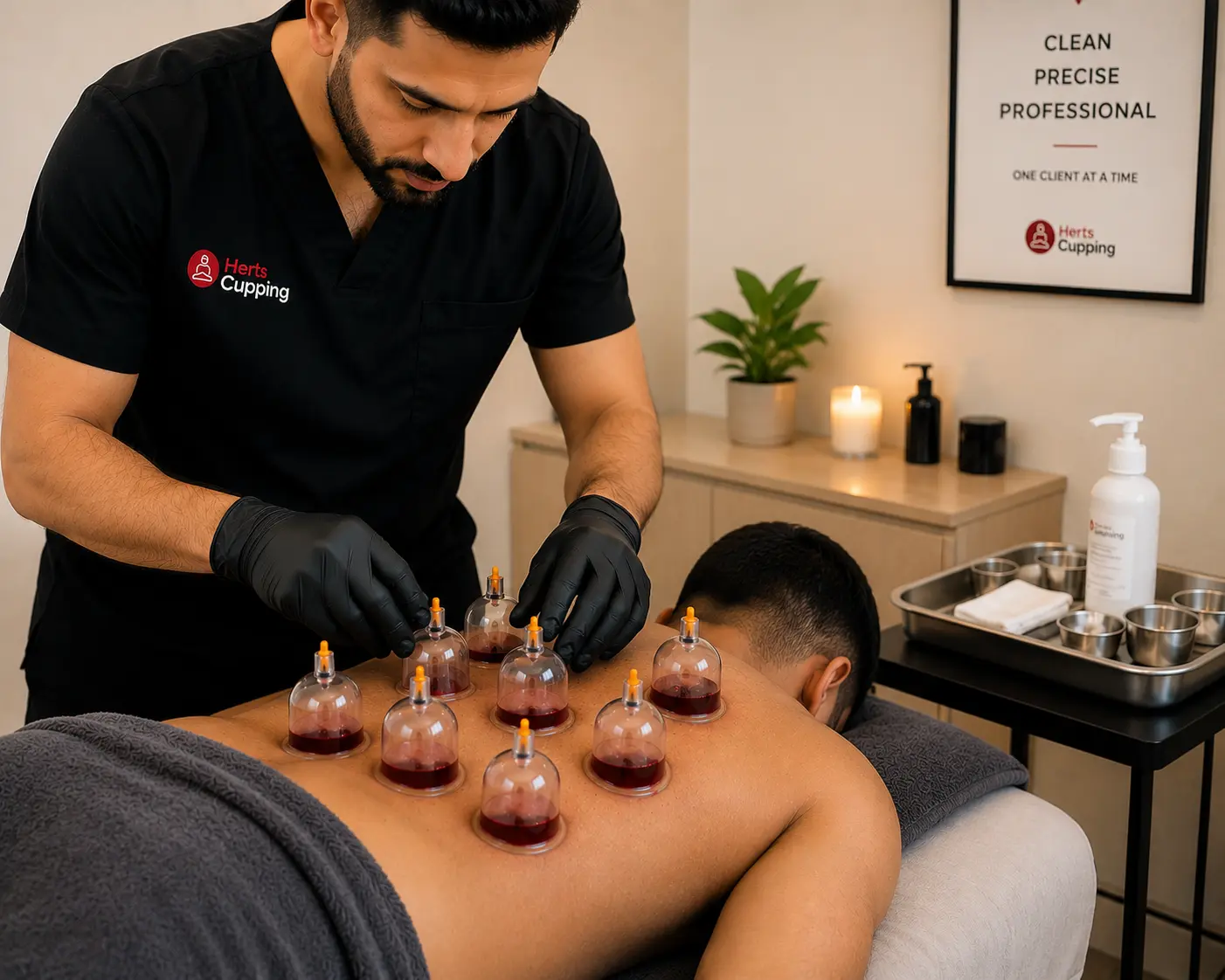
Hijama for Spiritual Wellbeing & Body Detox
Many of our clients come to us looking for relief from the physical symptoms that often accompany spiritual concerns. Persistent body heaviness, poor sleep, anxiety, low mood, and a sense of being run down. Hijama (wet cupping) is one of the most established treatments in the Sunnah for restoring physical balance, calming the body, and supporting the natural processes Allah has placed within it.
What this page is, and what it isn't
We offer Hijama as a physical treatment with strong basis in the Sunnah. We do not perform Ruqyah, diagnose spiritual conditions, or claim to remove sihr or ʿayn. What we do is provide a sterile, clinical, one-to-one Hijama session, and offer guidance below on the lawful steps the Sharīʿah outlines for those seeking spiritual relief.
Hijama in the Sunnah
Hijama is one of the most encouraged forms of physical treatment in Islam. The Prophet ﷺ underwent Hijama himself and recommended it to his Ummah on multiple occasions.
"Indeed, the best of remedies you have is cupping (Hijama)."
Narrated by Anas ibn Mālik (raḍiyallāhu ʿanhu). Ṣaḥīḥ al-Bukhārī 5371
"Healing is in three things: a gulp of honey, cupping, and branding with fire. But I forbid my Ummah from cauterisation."
Narrated by Ibn ʿAbbās (raḍiyallāhu ʿanhumā). Ṣaḥīḥ al-Bukhārī 5680
"I did not pass by an angel from the angels on the night of Isrāʾ except that they all said to me: 'Order your nation to perform cupping (Hijama), O Muhammad.'"
Narrated by Ibn ʿAbbās (raḍiyallāhu ʿanhumā). Sunan Ibn Mājah 3477 (graded ḥasan)
Seeking Treatment is From the Sunnah
Allah has placed cures within the means He created. Seeking treatment when unwell is itself an act of following the Prophet ﷺ.
"Seek treatment, O servants of Allah! For Allah has not sent down any disease except that He has also sent down its cure, except for one disease: old age."
Narrated by Usāmah ibn Sharīk (raḍiyallāhu ʿanhu). Sunan Ibn Mājah 3436 (graded ṣaḥīḥ)
This applies to physical illness and to the physical effects that accompany spiritual ailments. Tiredness, body pain, tightness, restlessness, and disturbed sleep are physical states. They have physical means of relief, and Hijama is one of the strongest from the Sunnah.
What Ibn al-Qayyim Said About Hijama
Imām Ibn al-Qayyim (raḥimahullāh, d. 751 AH) was one of the great scholars of Islamic medicine. In his renowned work Zād al-Maʿād, he discussed cupping at length, including its role for ailments that had both physical and unseen causes.
Ibn al-Qayyim · Zād al-Maʿād
"The Messenger of Allah ﷺ was cupped on his head when he was afflicted with sihr, and Hijama is from the best of cures for this when performed correctly."
Zād al-Maʿād, 4/125 to 126
Ibn al-Qayyim's broader point matters here. Hijama is a physical treatment that supports the body. Where there is physical heaviness, accumulated tension, or the residual physical effects of an ailment, cupping is one of the means the Prophet ﷺ used and recommended. It is not, in itself, a treatment for sihr or ʿayn. Those are addressed through the Qurʾān and authentic supplications. But the body still needs care, and Hijama gives it that care.
The Reality of ʿAyn (Evil Eye)
Ibn al-Qayyim explained the nature of the evil eye in clear terms.
Ibn al-Qayyim · Zād al-Maʿād
"The evil eye is like an arrow which comes from the soul of the envier towards the one envied. Sometimes it strikes him and sometimes it misses. If the target is exposed and unprotected, it may affect him. If the target is cautious and armed with remembrance and tawakkul, the arrow has no effect, and may even return upon the one who launched it."
Zād al-Maʿād, summarised
The Prophet ﷺ confirmed the reality of the evil eye:
"The evil eye is real, and if anything were to overtake the divine decree (qadar), it would be the evil eye."
Narrated by Ibn ʿAbbās (raḍiyallāhu ʿanhumā). Ṣaḥīḥ Muslim 2188
What Ibn Taymiyyah Said About Treatment
Shaykh al-Islām Ibn Taymiyyah (raḥimahullāh, d. 728 AH) was firm on what is and is not permissible when seeking cure for spiritual ailments. His ruling protects the believer from falling into shirk while pursuing relief.
Ibn Taymiyyah · Majmūʿ al-Fatāwā
"The scholars of Islam have prohibited any treatment in which the meanings are not understood, for it could be the reason for a person to fall into shirk even without realising it."
Majmūʿ al-Fatāwā, 19/13
Ibn Taymiyyah · Majmūʿ al-Fatāwā
"Ruqyah is a type of duʿāʾ. The Prophet ﷺ recited ruqyah for himself and for others, and this is something that is enjoined, for all the Prophets asked of Allah and prayed to Him."
Majmūʿ al-Fatāwā, 1/182
The position of Ibn Taymiyyah, alongside the wider scholarly consensus, is that lawful Ruqyah must come from the Qurʾān, the authentic Sunnah, or clear words of remembrance whose meaning is known and contains no shirk. Anything else, regardless of how effective it may appear, is to be avoided.
How to Address Spiritual Concerns Properly
If you suspect ʿayn, sihr, or other spiritual harm, the path forward is the path the Prophet ﷺ taught and the early generations followed. We do not perform Ruqyah at our clinic, but the steps below are well known among the scholars and accessible to every Muslim.
Self-Ruqyah is the strongest first step
The Prophet ﷺ recited Ruqyah on himself. Self-Ruqyah builds tawakkul, requires no intermediary, and avoids the risk of unqualified or misguided practitioners. ʿĀʾishah (raḍiyallāhu ʿanhā) narrated:
"The Messenger of Allah ﷺ used to seek refuge for some of his family, wiping over them with his right hand and saying: 'O Allah, Lord of mankind, remove this harm and heal, for You are the Healer. There is no healing except Your healing, a healing that leaves no illness behind.'"
Narrated by ʿĀʾishah (raḍiyallāhu ʿanhā). Ṣaḥīḥ al-Bukhārī 5675
The core sūrahs and verses for Ruqyah
The following are established in the Sunnah and used for self-Ruqyah, with full understanding of their meanings:
- Sūrah al-Fātiḥah, recited by Ṣaḥābah as Ruqyah. The Prophet ﷺ called it "the Mother of the Qurʾān"
- Āyat al-Kursī (al-Baqarah 2:255). The Prophet ﷺ said reciting it before sleep keeps a guardian over you
- The last two verses of Sūrah al-Baqarah (2:285 to 286)
- Sūrah al-Ikhlāṣ, al-Falaq, and al-Nās. The Prophet ﷺ recited these together over himself when ill
Practical steps
- Recite the above with focus and reflection, blowing lightly into the hands and wiping over the body
- Read into water, drink it, and bathe with it. This was practised by the Prophet ﷺ and his Companions
- Recite into olive oil and apply it to areas of pain or tension
- Maintain the morning and evening adhkār consistently. These are the daily fortress
- Increase istighfār, ṣalāh, and giving in charity
- Strengthen tawakkul. Harm only reaches you by Allah's permission, and so does relief
If you seek a Raaqi, choose carefully
Ibn Taymiyyah's warning above applies directly here. A Raaqi must use only the Qurʾān, authentic supplications, and clearly understood Arabic words. Avoid anyone who:
- Asks for personal items, names of relatives, or unusual information
- Uses words, symbols, or phrases whose meaning is not understood
- Claims to communicate with jinn or asks jinn for information
- Charges large sums or demands repeated sessions without clear basis
- Makes definitive diagnoses of sihr or ʿayn without clear evidence
- Discourages you from the standard means (medical, prayer, adhkār)
Where Hijama Fits Into All of This
Hijama supports the body. That is its role.
When someone has been carrying physical heaviness for weeks or months, whether from stress, anxiety, poor sleep, tension, or the physical fatigue that often accompanies prolonged spiritual concerns, the body needs care.
Our Hijama sessions are offered as a means of physical relief, alongside (not in place of) the spiritual steps above. Many clients book Hijama specifically to:
- Help the body recover from prolonged stress, anxiety, or fatigue
- Support better sleep and clearer mental state
- Release physical tension carried in the back, shoulders, and neck
- Follow the Sunnah of cupping for general wellbeing and detox
- Combine the physical Sunnah of Hijama with their own ongoing self-Ruqyah
You are welcome to recite Qurʾān or supplications quietly during your session if it brings you peace. The session itself is a private, sterile, one-to-one Hijama treatment. We will not perform Ruqyah for you, but we respect and support your intention to follow the Sunnah.
Book Hijama for Stress, Anxiety & Body Recovery
Whether you are looking for relief from prolonged stress, working through anxiety, or recovering from a difficult period that has worn the body down, Hijama is one of the strongest physical means in the Sunnah. Private, sterile, one-to-one. 100% single-use equipment. Tailored point selection. Female practitioner available on request.
As Ibn al-Qayyim noted in Zād al-Maʿād, Hijama is "from the best of cures when performed correctly," and the Prophet ﷺ himself underwent it for both physical and unseen ailments. We bring that same Sunnah into a clinical, modern setting.
Starter Hijama
£50
Up to 5 cups, focused area
Signature Hijama
£70
Up to 10 cups, full assessment
Advanced Hijama
£90
Extended coverage across multiple areas
A note on cure: healing comes from Allah alone. Hijama, Ruqyah, medicine, and every other means are causes that work only by His permission. We do not promise outcomes, only that we offer the physical treatment with care, sincerity, and adherence to the Sunnah.
Frequently Asked Questions
Do you perform Ruqyah at the clinic?
No. We offer Hijama as a physical treatment only. Ruqyah, when needed, is best performed by yourself based on the Sunnah, or by a qualified Raaqi who limits themselves to the Qurʾān and authentic supplications. We are happy to offer general guidance on lawful steps but do not provide Ruqyah as a service.
Can Hijama help if I think I have ʿayn or sihr?
Hijama can help the body recover from the physical symptoms many people describe in such cases. Heaviness, fatigue, tension, poor sleep, restlessness. It is not a treatment for the spiritual cause itself. The spiritual side is addressed through Qurʾān, ṣalāh, daily adhkār, and self-Ruqyah, as Ibn Taymiyyah and Ibn al-Qayyim discussed at length. Hijama supports the body while you take those spiritual steps.
Should I recite Qurʾān during my session?
If it brings you peace and helps your intention, yes, quietly. Many clients recite Āyat al-Kursī, the last three Quls (Sūrah al-Ikhlāṣ, al-Falaq, al-Nās), or other verses during their session. The practitioner will not recite for you. Your session is a calm, private, one-to-one space.
What's the best Hijama option for stress and general wellbeing?
Most clients choose Signature Hijama (£70). It includes a full assessment and up to 10 cups, giving comprehensive coverage of the back and other Sunnah points. If you have specific physical complaints alongside, Advanced Hijama (£90) gives wider coverage. If it's your first session and you'd prefer to start small, Starter Hijama (£50) is appropriate.
Do the Sunnah days (17th, 19th, 21st) matter for this kind of session?
The Sunnah days are recommended for general wellbeing and preventative Hijama. If you are booking specifically for the body's recovery and you can wait until those dates, it is encouraged. If you need relief sooner, do not wait. The Prophet ﷺ underwent Hijama outside those days when he needed treatment. View this month's Sunnah days here.
Is Hijama the same as removing sihr?
No. Ibn al-Qayyim noted that the Prophet ﷺ underwent Hijama on his head when affected by sihr, and that Hijama is among the best supportive treatments in such cases. But the actual removal of sihr in the Prophet's ﷺ case came through Allah revealing it to him and through Qurʾānic recitation (al-Falaq and al-Nās). Hijama supports the body during and after such episodes. It does not replace Qurʾān as the means of cure.
I'm experiencing severe distress, anxiety, or symptoms I can't explain. What should I do?
Please speak to a medical professional first. Many physical and mental health conditions present in ways that can feel spiritual, and they have real, treatable causes. Do not delay medical advice. Hijama, Ruqyah, and spiritual practice all sit alongside proper medical care, never instead of it.
Ready to Book?
Specialist Hijama in St Albans. Private, sterile, and one-to-one. Whether you're seeking detox, stress relief, or following the Sunnah, we'll give you the time and care your body needs.