Skip to content Skip to footer

Muscle Scraping & IASTM (Graston-Style Therapy) in St Albans

Also known as Graston Technique Muscle Scraping IASTM Soft Tissue Mobilisation

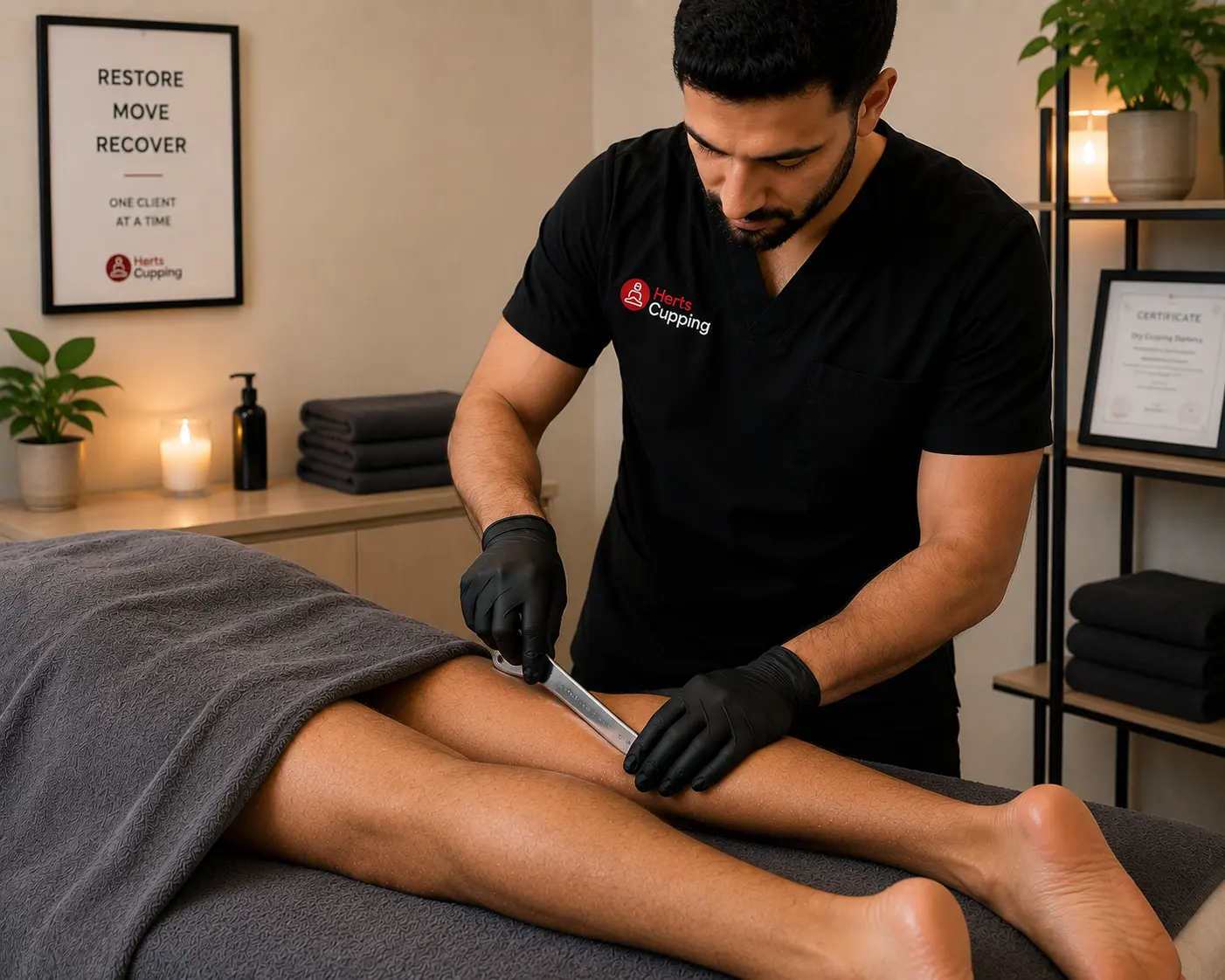
If you've heard of Graston therapy or muscle scraping on social media, what you're looking at is a form of IASTM (Instrument Assisted Soft Tissue Mobilisation). They're the same family of treatment, just different names. We use medical-grade stainless steel instruments to break down scar tissue and fascial adhesions that hands and standard massage cannot reach.

We are the only clinic in Hertfordshire offering IASTM alongside Hijama and clinical cupping in the same session. That combination means we address restrictions at multiple layers of tissue without you needing to book three separate appointments.

Not available at standard massage clinics.

Part of our specialist massage offering in St Albans. Muscle scraping is included in all Recovery Sessions alongside deep tissue massage, cupping and percussion.

View Full Massage Services →

It Works Like Massage. Just Deeper.

The Tool Is the Therapist's Hand

When a massage therapist works a tight muscle, they press, glide and drag their hands along the tissue to release it. Muscle scraping does exactly the same thing — the instrument is simply an extension of that. It glides along the surface of the muscle, applies directional pressure, and physically manipulates soft tissue.

The difference is depth and precision. A hand distributes force broadly. A stainless steel instrument concentrates it into a narrow edge, which means it can reach fascial restrictions that hands physically cannot get through. Many clients describe it as feeling like an intense, deeply focused deep tissue massage.

If you have ever had deep tissue massage and felt that the therapist was getting close to the restriction but not quite there, this is what bridges that gap.

What the tool does to the tissue

Glides along muscle fibres, like effleurage in massage

Applies sustained directional pressure into restricted areas

Physically mobilises tissue that hands cannot fully penetrate

Stimulates blood flow and the body's natural repair response

Releases fascial layers underneath the muscle surface

Is This Graston Therapy?

Short answer: it's the same technique, performed by an IASTM-certified practitioner using clinical-grade instruments rather than the official Graston-branded tools.

Graston Technique is a well-known American brand of IASTM that's become popular through social media and pro sports. Because the brand is so visible, "Graston" has become the everyday name for muscle scraping in general. The underlying method, drawing instruments across the skin to release fascial restrictions, is the same regardless of which tools are used.

Our practitioner trained through OMT Training and holds an International Diploma in Instrument Assisted Soft Tissue Manipulation. We use professional clinical instruments designed for the same purpose. If you came here looking for Graston therapy, this is what you're after.

How Does Muscle Scraping Work?

The instruments are drawn across the skin with controlled pressure, creating friction that targets fascial restrictions and scar tissue underneath. This triggers a localised response that stimulates the body's natural repair process.

It is not gentle and you will feel it working. But clients consistently report noticeable improvement in mobility and a reduction in tightness from the first session.

What Clients Come to Us For

The three outcomes people most commonly report after IASTM and muscle scraping sessions.

Scar Tissue and Adhesion Release

Old injuries, post-surgery tightness, and chronic knots that have become permanent. The instruments reach restrictions that manual massage cannot.

Improved Mobility

Clients regularly notice increased range of motion after their first session. For anyone who lifts, runs, sits at a desk, or just feels stiffer than they used to.

Pain That Massage Has Not Fixed

If you have had multiple massages and the pain keeps returning, the issue is likely in the fascia, not the muscle. Muscle scraping targets the fascial layer directly.

Why We Combine Muscle Scraping With Cupping and Deep Tissue

Most clinics offer one technique. We combine three in the same session. The IASTM (muscle scraping) breaks down the restriction. The cupping decompresses the tissue and draws stagnation away. The deep tissue massage releases the surrounding tension.

Together they address the problem at multiple layers. This is what our Recovery Sessions are built around. It is not a gimmick. It is a better way to treat stubborn restrictions than scraping alone.

IASTM, Graston, Gua Sha: What's the Difference?

These three terms come up constantly online and they often get confused. Here's the honest breakdown.

IASTM
The clinical, generic name for the entire category. Stands for Instrument Assisted Soft Tissue Mobilisation. Practitioners are typically certified through training programs like OMT, and the tools are designed for precise fascial work. This is the umbrella term.
Graston Technique
A specific American brand of IASTM, popularised through chiropractic, sports therapy, and social media. Uses its own branded instruments and certification. The technique itself is IASTM. The name is the brand.
Gua Sha
The original, ancient Chinese technique that inspired modern IASTM. Uses broader strokes with simpler tools (traditionally jade or buffalo horn). Less precise than IASTM but shares the same core principle. Don't confuse it with cosmetic facial Gua Sha, which is far gentler.
What We Offer
IASTM using clinical-grade instruments, performed by a practitioner with an International Diploma from OMT Training. Combined with Hijama, deep tissue massage and cupping in the same session.

Not Just for Pain

While most clients come to us for pain or tightness, muscle scraping also helps with general tension, stress-related tightness, and recovery after training. The controlled pressure releases held tension in the fascia, which many clients find deeply relieving even when they are not dealing with a specific injury.

Combined with Hijama, which is widely used for stress, anxiety, and overall wellbeing, we can address both the physical and the general tension in one visit.

Commonly Treated Conditions

Muscle scraping (IASTM / Graston-style work) is particularly effective for restrictions that have not responded to massage or stretching alone.

Plantar Fasciitis

Targets the thick fascial restriction along the sole of the foot causing heel and arch pain.

Tennis / Golfer's Elbow

Reduces tension in the forearm tendons and surrounding tissue. Often combined with cupping.

Lower Back Stiffness

Targets the thoracolumbar fascia to release restriction and improve spinal rotation.

Shoulder Impingement

Works on restrictions around the rotator cuff to restore smoother overhead movement.

Gym and Training Recovery

Breaks down fascial tightness from heavy lifting, running, or repetitive training. Improves recovery between sessions.

Desk Posture Tension

Releases restriction in the upper back, neck, and shoulders from prolonged sitting. Common in office workers.

Your Practitioner

Every session is with Abdus Shahid. International Diploma in Instrument Assisted Soft Tissue Manipulation (OMT Training), Myofascial Cupping Practitioners Diploma, Diploma in Trigger Point Therapy, and certified in Hijama Cupping Therapy. One of the only practitioners in Hertfordshire qualified to combine all four in a single session.

Sessions That Include Muscle Scraping

IASTM (muscle scraping / Graston-style work) is included as standard in every Recovery Session. Every session also includes a full assessment, sterile setup where applicable, and written aftercare.

Targeted Recovery

60 MINS

Massage, cupping and IASTM. No Hijama. Focused on one or two areas.

£75

Most Clients Choose This

Targeted Recovery + Hijama

60 MINS

Recovery session with IASTM and Hijama wet cupping included.

£95

Full Body Recovery

90 MINS

Full-body massage, cupping and IASTM. No Hijama. Best for multiple areas or a full reset.

£110

Full Body Recovery + Hijama

90 MINS

Full-body recovery with IASTM and Hijama across multiple areas.

£135

Returning client? Lower rates apply for sessions booked within 8 weeks of your last visit. Mention it when you book.

Looking for Hijama Instead?

If you are looking for Hijama (wet cupping) on its own, without the deep tissue and scraping work, we offer standalone Hijama sessions from £50. Used for pain, stress, tension and overall wellbeing.

View Hijama Sessions →

Frequently Asked Questions

Is what you offer the same as Graston therapy?

Yes, in terms of the technique itself. Graston is the most well-known brand of IASTM (Instrument Assisted Soft Tissue Mobilisation), so most people search for "Graston therapy" when they actually mean muscle scraping in general. We use clinical-grade instruments and our practitioner trained through OMT Training, holding an International Diploma in IASTM. The principles, the work, and the outcomes are the same. We just don't use the specific Graston-branded tools or hold their certification.

Is muscle scraping a type of massage?

In a functional sense, yes. The instrument physically glides along muscle fibres, applies directional pressure and manipulates soft tissue, which is what manual massage does. The key difference is that the tool can concentrate force into a narrow edge and reach fascial restrictions that hands cannot fully penetrate. Many clients describe it as feeling like a very focused, intense deep tissue massage. It is always used here alongside hands-on massage rather than instead of it.

Does muscle scraping hurt?

It is not comfortable in the way a relaxation massage is. You will feel pressure and friction as the instruments work on restricted areas. Most clients describe it as a "good pain" that they can feel working. We adjust intensity throughout and you can ask us to ease off at any point.

Is IASTM the same as Gua Sha?

They share a similar principle but differ in application. Gua Sha is rooted in traditional Chinese medicine and uses broader strokes. IASTM uses precision-engineered medical-grade instruments and is based on clinical soft tissue research. The instruments we use allow us to target specific restrictions with more accuracy.

Can I have IASTM on its own?

IASTM is included as part of our Recovery Sessions alongside cupping and deep tissue work. We do not offer it as a standalone treatment because it works best when combined with the other methods in the same session.

Will it leave marks?

Muscle scraping can cause temporary redness and minor bruising in areas where there is significant fascial restriction. This is normal and typically fades within a few days. It is a sign that the tissue has been worked on effectively.

How many sessions will I need?

This depends on the issue. Some clients feel a significant difference after one session. Others with chronic restrictions benefit from a series of two to four sessions spaced one to two weeks apart. We will advise you after your assessment.

Do you have a female practitioner?

Recovery Sessions including IASTM are currently performed by Abdus Shahid only. We have a female practitioner available for Hijama sessions. Please WhatsApp us to discuss availability.

Not Sure If This Is Right for You?

If you are dealing with tightness, restriction, or pain that has not responded to massage, drop us a message. We will let you know whether muscle scraping would help or if a different approach makes more sense.