In this article
Hijama points are not random dots copied from a chart. Some points are established from the Sunnah, especially the two sides of the neck and the area between the shoulders. Other areas, such as the head or foot, are mentioned in narrations linked to specific pain or need,...
Sunnah Hijama Points: What Is Actually Established?
The clearest and most commonly established Sunnah Hijama points are the two sides of the neck and the area between the shoulders. These are the main points people usually refer to when they ask for Sunnah Hijama points.
The head is also established in the narrations as an area where the Prophet Muhammad ﷺ had cupping done. It is mentioned in relation to head pain or headache, and also reported that he was cupped on his head while in Ihram.
Clearer wording: the two sides of the neck and the area between the shoulders are the main confirmed Sunnah Hijama points people usually refer to. The head is also established in the narrations, but we still assess whether head cupping is suitable for the person in front of us.
What About the Foot and Other Points?
The foot and some other areas are different. They are often discussed because of narrations linked to pain, injury or need-led cupping. That does not automatically mean every person should treat those areas as fixed Sunnah points in the same way as the neck and between the shoulders.
This is where there can be difference of opinion in how people label certain areas. Some may call them Sunnah points. Others may describe them more carefully as points where cupping was performed for a specific pain or need.
Important distinction: some areas are established as commonly cited Sunnah Hijama points. Other areas are better understood as pain-led or need-led cupping based on specific circumstances. Where there is difference of opinion, I avoid presenting doubtful points as fixed Sunnah points.
The Two Meanings of Hijama Points
Established Sunnah Areas
These are areas that have clear basis in the narrations, especially the two sides of the neck and between the shoulders. The head is also established as an area where cupping was done.
Pain-Led Treatment Areas
These are chosen after assessment. If someone has pain, tightness or heaviness, we look at the actual pattern instead of blindly copying a chart.
Why We Do Not Use Random Hijama Point Charts
Many Hijama charts online list dozens of points and attach a body part, organ or condition to each one. The problem is that people then assume every point is equally authentic, equally established or medically proven.
That is not how we work. I do not tell clients that a cup on one point will fix their liver, kidneys, thyroid, fertility, stomach or any other organ. That is not a responsible way to present Hijama.
Hijama may support general wellbeing, relaxation, recovery and the release of tension, but it should not be sold with false certainty or medical promises.
No organ-cure claims: cup placement can be Sunnah-led, pain-led or assessment-led. It should not be presented as a guaranteed treatment for internal organs or diagnosed medical conditions.
How We Approach Hijama Points at Herts Cupping
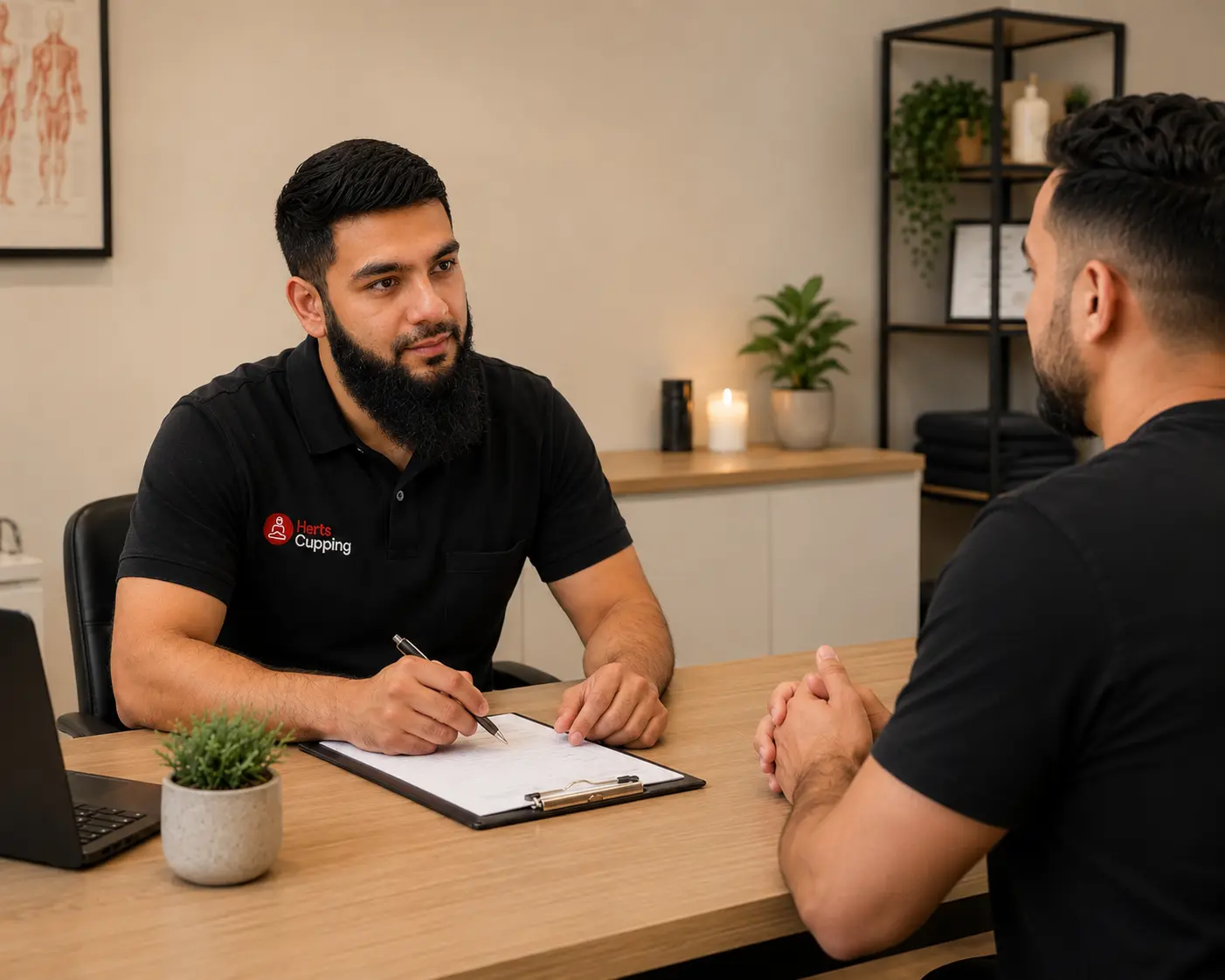
Our method is simple: start with authenticity, check suitability, assess the client, then follow what the body is showing. We do not just place cups everywhere and hope for the best.
If someone books for Sunnah Hijama, we discuss the established areas first. If someone books because of pain, stiffness or heaviness, we follow the trail of the pain and look at the areas that may be contributing to it.
1We Start With Authenticity
We do not label every popular point online as a Sunnah point. The wording has to be honest and careful, especially when dealing with religious matters.
2We Check Suitability
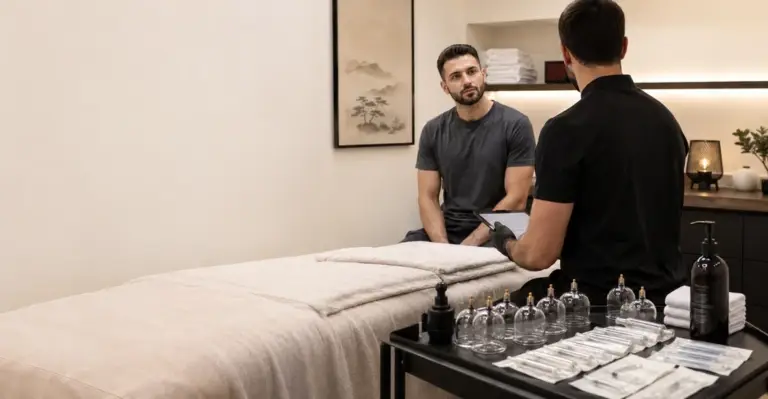
Not every point is suitable for every person. Medication, health history, fainting risk, skin condition, sensitivity and the client’s general state all matter.
3We Follow the Pain Pattern
If someone has pain or tension, we look at the surrounding areas too. Neck pain may involve the upper back and shoulders. Lower back pain may involve the hips, glutes or hamstrings.
4We Choose the Right Pressure
The cup pressure and number of cups should suit the client. Stronger suction and more cups are not automatically better.
5We Avoid Exaggerated Claims
Hijama may support recovery and wellbeing, but we do not claim that a specific point cures a disease, fixes an organ or guarantees a result.

Illustration showing the difference between established Sunnah areas, pain-led cupping and our assessment-led approach at Herts Cupping.
Following the Trail of Pain
When a client comes in with pain, the painful spot is not always the only area that matters. This is especially true with neck, shoulder, lower back and leg tension.
For example, someone may point to the neck, but the upper back and shoulders are heavily involved. Someone may complain of lower back tightness, but the hips, glutes or hamstrings may be part of the pattern. Someone may feel tension in the head, but the neck and upper back may also need to be assessed.
This is why we do not work from a generic Hijama chart alone. We listen, assess, check suitability and then choose the safest and most relevant points for that session.
Our method: authentic where it is Sunnah, practical where it is pain-led, and honest where there is uncertainty. No shortcuts, no fake certainty and no exaggerated point claims.
Can You Ask for Specific Points?
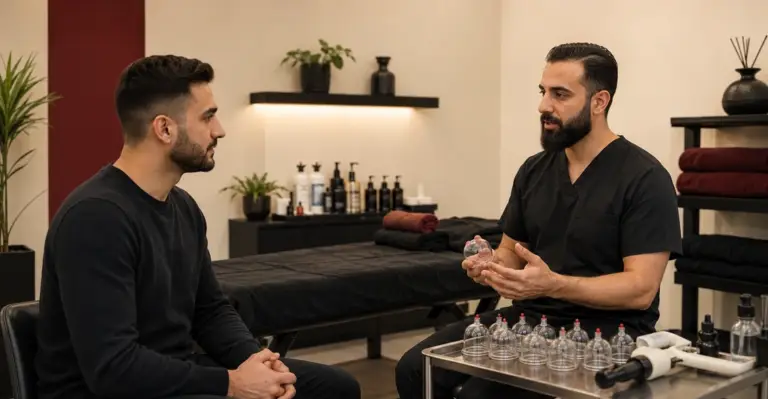
Yes, you can tell us which areas you want treated. If you want the established Sunnah areas, say that. If you have pain in a particular place, explain where it starts, where it travels and what makes it worse.
But the final placement still needs to be suitable. If an area is not appropriate for wet cupping on the day, I will explain why. Sometimes dry cupping, massage, IASTM or a different approach is more sensible than wet cupping on a specific point.
How Many Hijama Cups Are Enough?
This is another area where people get misled. Some people think a good Hijama session means lots of cups everywhere. That is not always wise.
For a first-time client, I may keep it more controlled. For someone experienced, fit, well-hydrated and used to cupping, more areas may be appropriate. For someone sensitive, nervous or tired, fewer cups can be the better choice.
My rule: enough to be useful, not so much that it becomes unnecessary stress on the body.
What We Do Not Do
- We do not copy random online charts blindly.
- We do not call every point a confirmed Sunnah point.
- We do not claim that a specific point treats a specific organ.
- We do not use excessive cups just to make the session look dramatic.
- We do not ignore safety, suitability or client comfort.
What We Do Instead
- We respect the established Sunnah areas.
- We explain areas of difference carefully.
- We assess the person in front of us.
- We follow the pattern of pain, tension and restriction.
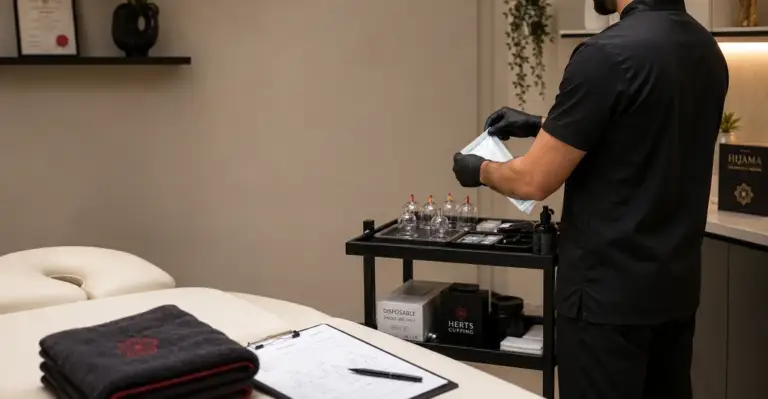
- We use safe, clean and suitable cup placement.
- We keep the claims honest and realistic.
Related Pages
- Hijama Hadith - Islamic references and Sunnah context
- Sunnah Hijama Dates - updated monthly Hijama date guidance
- What Is Hijama? - a simple guide to wet cupping
- Hijama Aftercare - what to do before and after treatment
- Book an Appointment - view available sessions
Common Questions
Which Hijama points are confirmed from the Sunnah?
The clearest commonly cited points are the two sides of the neck and the area between the shoulders. The head is also established as an area where the Prophet ﷺ had cupping done, including in relation to head pain. Other areas should be discussed more carefully because scholars and practitioners may differ on whether they should be labelled as fixed Sunnah points or pain-led cupping areas.
Is the head a Sunnah Hijama point?
The Prophet ﷺ had cupping done on his head, and narrations mention head cupping in relation to head pain or headache. I explain it as an established area from the narrations, but I still assess suitability before doing head cupping because it is not suitable for every person.
Is the foot a Sunnah Hijama point?
The foot is often discussed because of narrations linked to pain or need-led cupping. I would not present it the same way as the main neck and shoulder points. If foot cupping is considered, it should be based on the client’s situation, suitability and the reason for treatment.
Do Hijama points treat specific organs?
No. I avoid organ-chart claims. A cup placed on the back should not be advertised as treating a specific organ. Placement should be based on authentic guidance, safe areas, assessment, muscle tension, client goals and suitability.
Are Hijama points fixed for everyone?
No. Some people ask for established Sunnah areas, while others need cup placement based on assessment. I do not believe every person should receive the exact same cup layout without checking what is suitable.
How many cups do I need for Hijama?
There is no magic number. A first session may use fewer cups if you are new, sensitive or only need specific areas treated. More cups is not automatically better. The right number depends on your body, your goal and how well you tolerate suction.
Book Hijama in St Albans
Private one-to-one Hijama sessions at Herts Cupping. Book online or message first if you are unsure which points or treatment type are right for you.
Book a Session WhatsApp Us