
Qur’anic recitation
Legitimate Ruqyah centres on reciting Qur’an and authentic supplications. It does not require amulets, unknown symbols, secret diagrams or occult practices.
Ruqyah · spiritual wellbeing · clear boundaries
A clear guide to wet cupping (Hijama) alongside Ruqyah while keeping the boundaries separate. Hijama is a physical practice, not a diagnosis of unseen causes.
The key distinction
Ruqyah is recitation of the Qur’an and authentic supplications seeking Allah’s protection and healing. Hijama is blood cupping, commonly called wet cupping. A person may choose both as part of their own religious and wellbeing routine, but one does not become a diagnostic test for the other.
Keep the roles clear
Each topic has its own place. The selector keeps the religious and physical treatment context clear without repeating the same boundary across separate sections.
Ruqyah in simple terms
The aim is not to create fear around normal life events or to turn every symptom into an unseen diagnosis.
Legitimate Ruqyah centres on reciting Qur’an and authentic supplications. It does not require amulets, unknown symbols, secret diagrams or occult practices.
Humans do not have independent access to the unseen. Feeling tired, anxious, in pain or having a difficult period in life is not proof of sihr, jinn or evil eye.
Seeking Ruqyah does not prevent someone from seeing a GP, therapist, physiotherapist or another appropriate professional when a physical or mental-health issue needs assessment.
Where Hijama fits
Hijama is established in authentic Islamic tradition and many Muslims choose it for Sunnah-based wellbeing. If somebody is also practising Ruqyah privately, they may choose Hijama at a similar time because both matter to them personally.
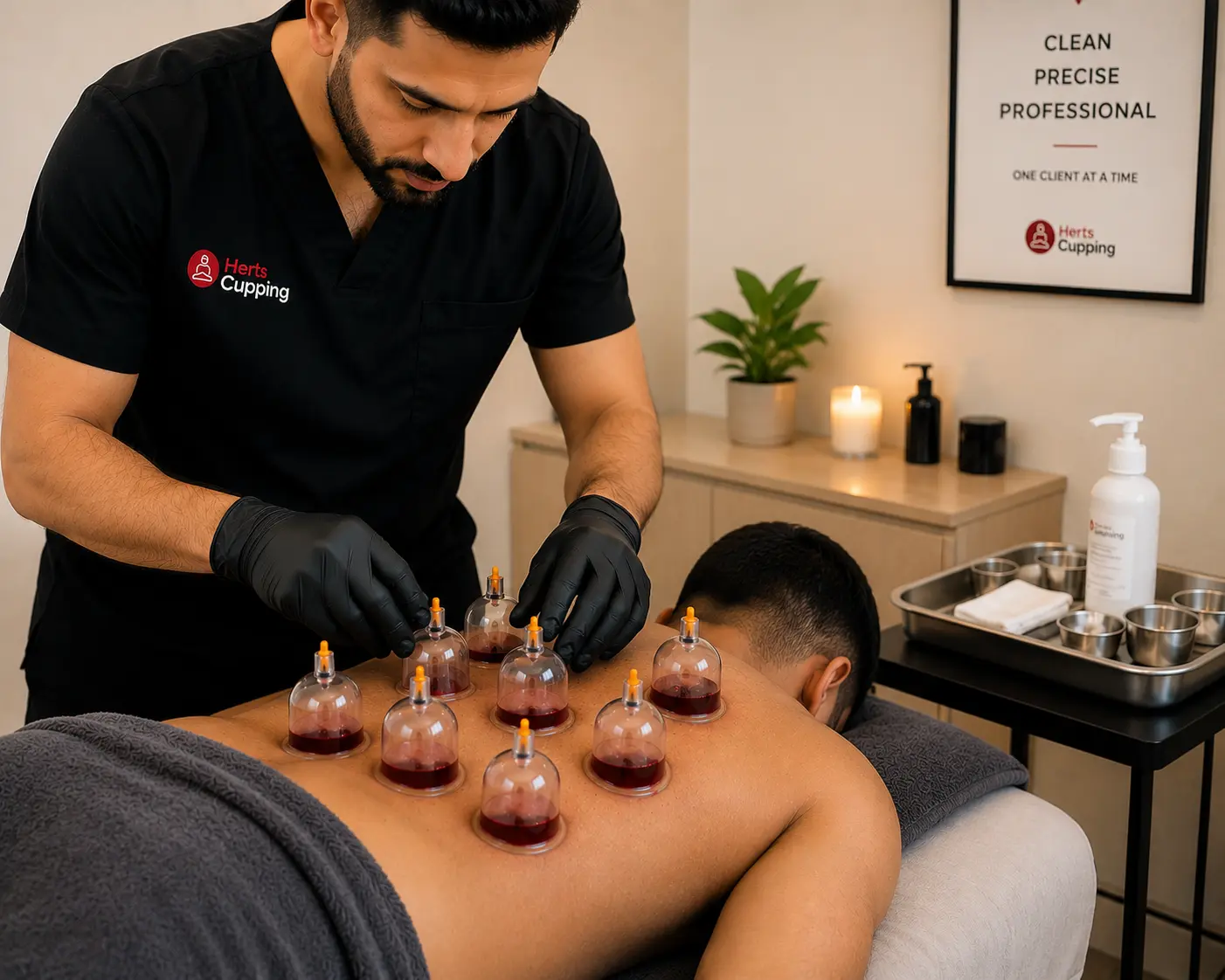
In clinic, however, we still treat Hijama as Hijama. We assess physical suitability, use sterile single-use equipment, select points safely and give ordinary aftercare. We do not change the procedure into an occult ritual or tell you that a cup has “pulled out” a jinn or sihr.
If your main reason for booking is physical tightness, pain or training recovery, tell us that clearly so the treatment can be chosen around the physical issue.
What we will not tell you
This protects clients from fear-based treatment and from having normal symptoms mislabelled as something supernatural.
Cup marks vary for ordinary physical reasons such as skin response and suction. They are not evidence of magic.
The colour or texture of blood in a Hijama cup cannot tell a practitioner whether a jinn is present.
Hijama can be chosen as a Sunnah practice, but we do not guarantee that a session will remove an unseen problem.
We do not use amulets, occult diagrams, numerology, secret writing or practices that cannot be clearly explained.
You will not be told you need repeated Hijama because a mark “shows” something is still attached to you.
Practical boundaries
Use these two topics for suitability, medical boundaries and what the clinic experience actually looks like.
Do not miss a physical or mental-health problem
Headaches, sleep disturbance, low mood, panic, pain, weakness, palpitations, neurological symptoms and many other experiences can have ordinary physical or psychological explanations. Ruqyah does not require you to ignore those possibilities.
If symptoms are severe, new, worsening, unexplained or affecting daily function, seek appropriate healthcare. If you are in immediate danger or acutely unwell, Hijama is not the first step.
Our role is limited to the services we are trained to provide. We can explain Hijama, check whether wet cupping is physically suitable and tell you when we think another professional should assess the problem first.
What a session here looks like
There are no theatrical claims or rituals around the treatment.
You can tell us whether your reason is Sunnah wellbeing, a physical issue or simply that you want Hijama.
We ask about medication, health conditions and anything relevant to safe wet cupping.
The session follows the same sterile wet-cupping process used for every suitable client.
You leave with practical physical aftercare, not a diagnosis of the unseen.
Hijama sessions
Every Hijama appointment includes consultation, tailored point selection, sterile single-use equipment and aftercare. We do not force every client into the same number of cups.
Useful for a small number of points, a focused area or clients who specifically want limited coverage.
Book Starter HijamaAllows a broader tailored point selection while keeping the session focused on the reason you booked.
Book Signature HijamaFor clients who want more extensive wet-cupping coverage across multiple suitable areas.
Book Advanced HijamaCommon questions
These are the practical questions clients ask most often. If your situation is more specific, message us before booking.
We do not claim that Hijama can diagnose or guarantee removal of sihr or jinn. Hijama is a physical wet-cupping practice and a Sunnah. Ruqyah is a separate religious practice based on Qur’an and authentic supplication.
No. Mark colour and blood appearance are not reliable ways to identify an unseen cause.
A person may choose both as part of their own religious and wellbeing routine, provided Hijama is physically suitable. They should still be understood as separate practices.
The clinic service is Hijama and recovery treatment. We can keep the environment respectful of your religious practice, but we do not turn the treatment into an unseen diagnosis or theatrical Ruqyah service.
Yes, where symptoms need medical or mental-health assessment. Seeking lawful religious remedies does not require ignoring ordinary healthcare.
No. We do not use amulets, unknown symbols, occult diagrams or practices that cannot be clearly explained.
Female practitioner availability is for Hijama only and is limited. Please WhatsApp first to confirm.
Private clinic · St Albans
If you want Hijama as a Sunnah and wellbeing practice, book normally. If you are unsure whether your concern is better addressed medically, physically or simply with information first, message us.