In this article
Sports massage timing depends on what you need to do next. Lighter preparation before training is not the same as deep recovery work after a hard block. The best timing is based on treatment intensity, your next session and whether the goal...
The short answer
You can have sports massage before or after training, but the session should change depending on the timing. Strong deep-tissue work immediately before a hard performance is very different from lighter preparation work. After training, there is usually more room for recovery-led treatment, but the next workout still matters.
The simplest rule is to tell the practitioner what you did last, what you need to do next and how you want to feel when you leave.
Before training: the goal is usually preparation
If you have an important gym session, match, run or event shortly afterwards, a very aggressive treatment is rarely the obvious choice. Strong pressure, prolonged work on tender areas, heavy IASTM or cupping can leave muscles feeling temporarily sore or simply different.
That may be acceptable when you have recovery time. It may be unhelpful when you need to perform two hours later.
Pre-training work is therefore usually shorter, more focused and guided by the event. The aim is not to “break down every knot”. It is to avoid creating a new problem right before performance.
After training: there is more room for recovery-led work
After a hard session, match or training block, there is usually more freedom to work through loaded areas. Even then, harder is not automatically better.
A footballer between fixtures, a runner with another long run in two days and a lifter entering a deload all have different recovery windows. If the next hard session is tomorrow morning, the treatment decision should reflect that.
Our Sports Recovery sessions are built around training load for exactly this reason.
What about booking on a rest day?
A rest day can be an excellent time because there is no immediate performance demand. It can also give us more space to work on several connected areas.
But “rest day” on a calendar does not always mean a real recovery window. If you trained hard yesterday and have another heavy session tomorrow, I still need to know both. The overall week matters more than the label on that day.
How deep should a pre-event massage be?
There is no universal pressure setting called “sports massage”. Treatment depth should be adjusted to the person and the timing. A client who wants to feel loose before a competition may need a very different session from somebody who has finished a training block and has three quiet days afterwards.
If you know deep work usually makes you sore, say so. Previous response is useful information.
Where dry cupping and IASTM fit
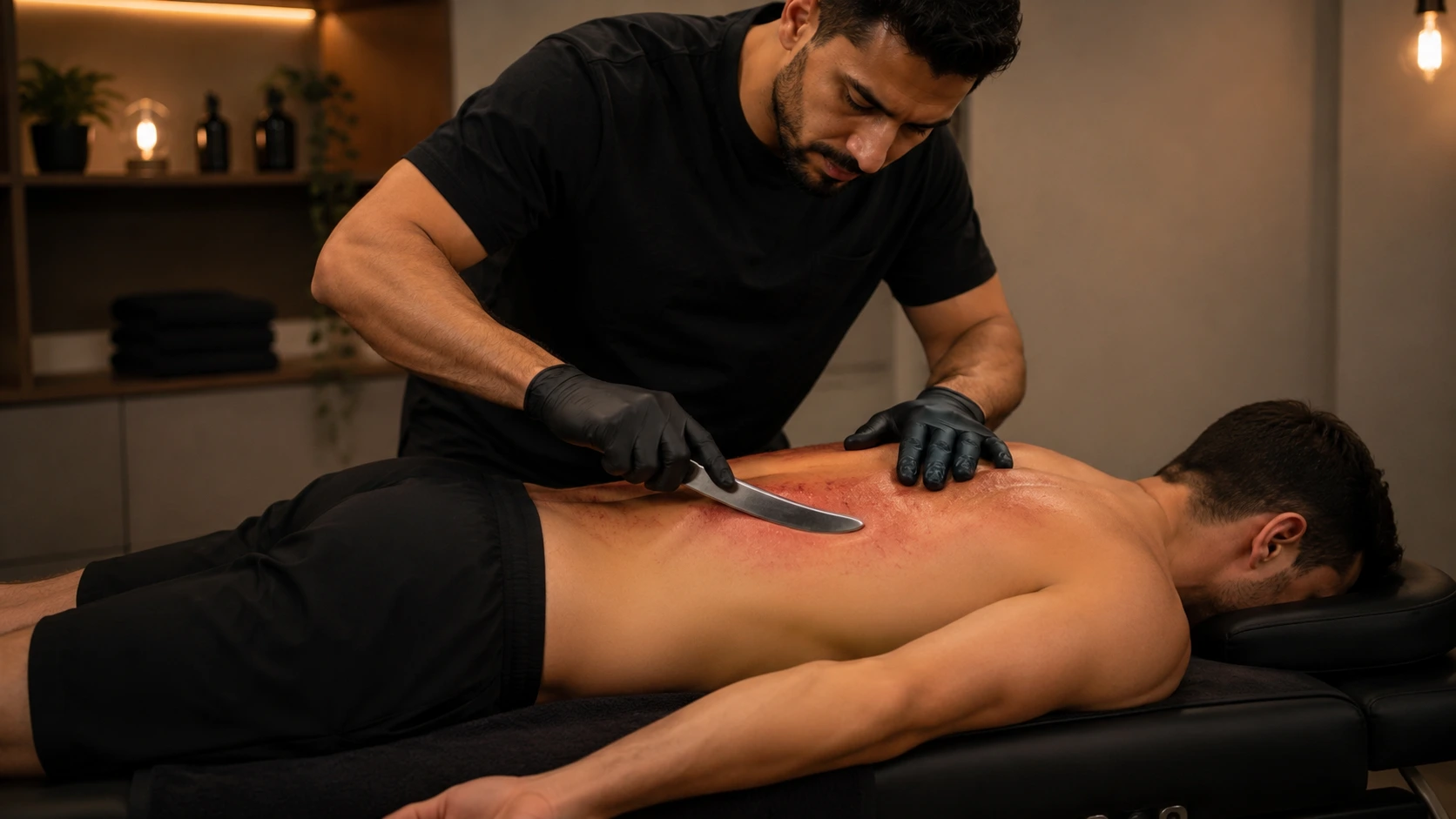
Dry cupping and muscle scraping can be useful inside recovery work, but they are not automatically added because the client is athletic. They can also leave visible marks, which may matter before competition, swimming, a photoshoot or another event.
IASTM can leave temporary redness or darker areas. Our guide on muscle scraping marks explains what those responses can and cannot tell you.
If visible cupping marks are a concern, tell us before the session so the treatment plan can be adjusted.
Timing examples that make the decision easier
Heavy lower-body session tonight
If you want treatment this morning, keep it conservative enough that it does not leave the legs sore or strange before the session. If the main goal is deeper recovery, tomorrow or the following day may give more room.
Football match yesterday, light training tomorrow
A recovery-led session today may fit well, depending on soreness and any injury concerns. New swelling, instability or sharp pain should be assessed rather than treated as normal post-match tightness.
Race or competition this weekend
If you are not used to deep treatment, do not experiment with a very aggressive session immediately before the event. Familiar, lighter work is usually easier to predict.
Deload week
This can be a useful window for more substantial work because the training demand is already lower.
What if you are already very sore?
Delayed soreness after training does not automatically need hard massage. Sometimes recovery is better served by sleep, food, hydration and gentle movement. If a region is extremely tender, swollen or behaving differently from ordinary muscle soreness, do not assume it needs more pressure.
Treatment should be useful, not punitive.
What I need to know before a sports recovery session
- What was your last hard session?
- When is the next one?
- Is there a match, race or competition coming up?
- Which area is affecting performance or recovery?
- Is the issue ordinary tightness or a new injury?
- How do you usually respond to deep treatment?
That information is more useful than a rigid rule such as “always massage 24 hours after exercise”.
Sports massage or full Muscle Recovery?
If you mainly want hands-on massage, see the Sports Massage St Albans page. If you want a session that can also use dry cupping, IASTM or a massage gun around the same muscular goal, choose Muscle Recovery.
The live booking page shows the route first and the calendar immediately afterwards.
When not to book ordinary sports massage
Significant swelling, suspected fracture, acute trauma, new weakness, loss of power, unexplained severe pain or neurological symptoms should be assessed appropriately. Massage and cupping are not substitutes for diagnosis or rehabilitation when an injury needs that level of care.
Common questions
How long should I leave between deep massage and training?
There is no fixed number that suits everyone. It depends on how deep the treatment is, how you usually respond and what the next training session requires.
Is sports massage better on a rest day?
Often it is convenient because there is no immediate performance demand, but the previous and next training sessions still matter more than the calendar label.
Can I have cupping before a competition?
It can be done, but consider treatment intensity and visible marks. If you are close to competition, tell the practitioner so the session can be adjusted.