In this article
If you consciously drop your shoulders but find them creeping back up minutes later, the problem may be less about one “tight muscle” and more about the position, workload and recovery pattern your body repeats all week.
Stress-related shoulder tension
This article focuses on the physical pattern of shoulders staying elevated or tense during prolonged stress. For training and desk-related loading, use the separate recurring-shoulder-tightness article.
See the stress-related body tension pageThe short answer
If your shoulders keep rising again after you deliberately relax them, you are probably dealing with a repeated pattern rather than a muscle that has simply forgotten how to loosen. Work, screens, driving, carrying, training, sleep and how often you stay in one position can all contribute.
The useful goal is not to force the shoulders down all day. It is to understand why the area keeps taking load, reduce the repeated triggers where possible and use treatment as support rather than expecting one session to erase the rest of the week.
Your body practises the positions you repeat
Many people spend far more time in one working position than they realise. A laptop, steering wheel, phone, treatment couch, tools or a counter can keep the arms in front of the body for hours. The shoulders do not need to be in a dramatic “bad posture” for the area to feel overloaded. Repetition alone can be enough.
This is why a quick stretch can feel good but not create a lasting change. Two minutes of stretching has to compete with the next six hours of the same task.
Instead of asking whether your posture is perfect, ask whether you have enough variation. Can you change position? Can you stand up? Can you move the arms overhead comfortably? Can you break one long sitting block into several shorter ones?
Why the upper traps get blamed for everything
When the top of the shoulders feels hard or tender, the upper trapezius is an obvious target. It is easy to press, massage or scrape. The mistake is assuming that because it feels tight, it must be the only problem.
The neck, shoulder blade, chest, lats and upper back all contribute to how the region moves. A client may point to the top of one shoulder while the larger pattern involves several connected areas. That is why treatment should not automatically spend an hour attacking the sorest two inches.
More pressure is not always the answer either. An area that has been working hard all week may be sensitive because it is already doing a lot.
Desk work and gym training can load the same region differently
A desk worker may accumulate low-level tension from long static periods. A gym client may load the same region through pressing, rows, pull-ups, carries, shrugs or overhead work. Some people do both.
That matters because the recovery plan has to fit what happens next. If the shoulders are loaded at work all day and then trained hard at night, there may be very little genuine recovery time between exposures.
This does not mean stop training. It means the programme, exercise selection and recovery window are part of the conversation. Our Sports Recovery guide explains how treatment is planned around training rather than in isolation.
Why one shoulder can feel worse than the other
Most people are not perfectly symmetrical. You may use a mouse with one hand, carry a bag on one side, sleep in a preferred position, rotate towards one screen or favour one arm in training.
Previous pain can also change how you distribute work. If one side has been guarded for months, the other side may quietly do more. That is why the side that feels tight is not always the only side worth checking.
We see the same principle in clients who complain about one side but show more visible skin response or tenderness elsewhere during treatment. That is useful context, not a diagnosis. Colour change under IASTM or cupping is not a test for which side is “damaged”.
What I look at before deciding how to treat it
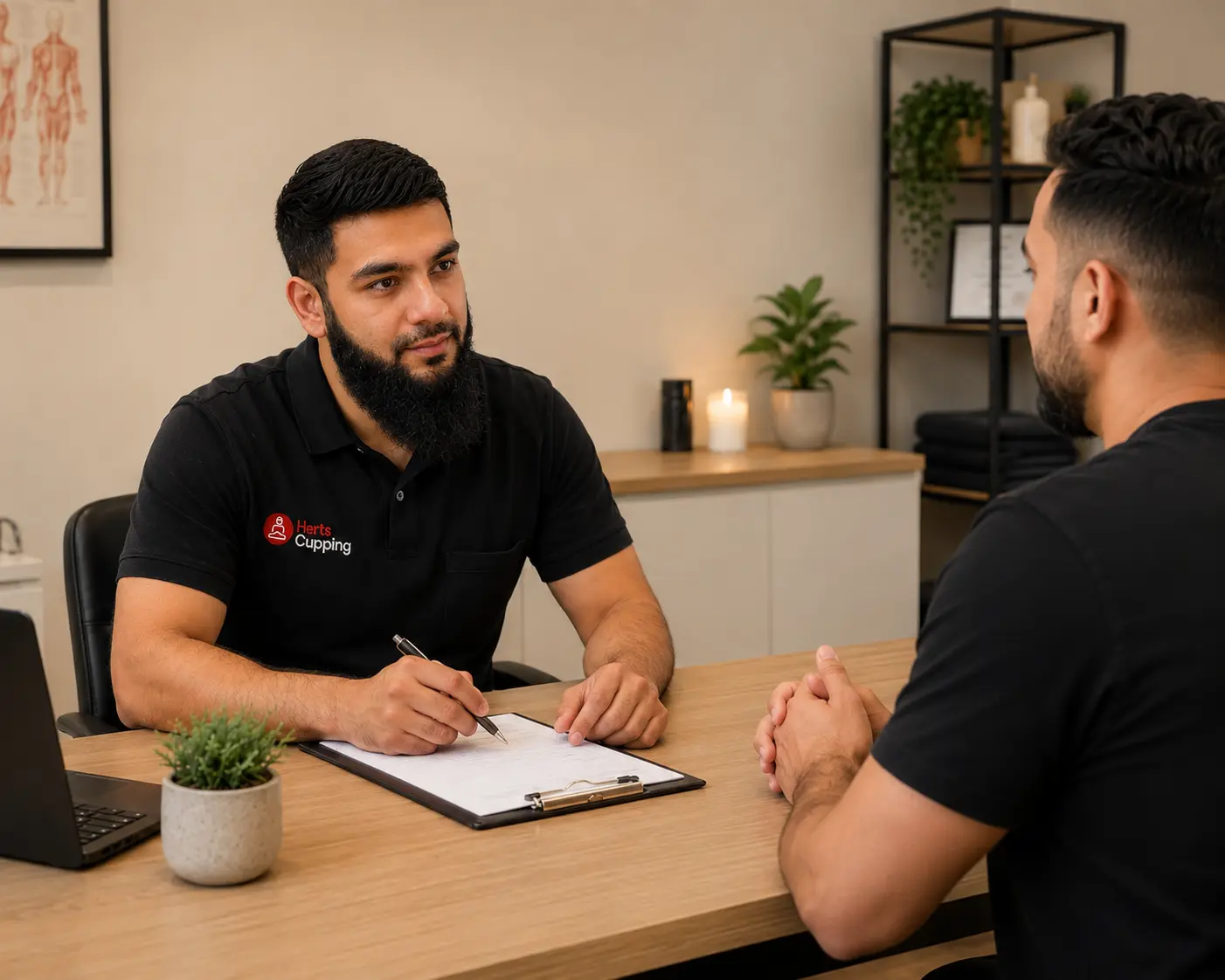
I want to know whether the tightness is constant or task-specific. Does it build through the working day? Is it worse after pressing or pulling? Does the neck move freely? Is the main complaint the top of the shoulder, between the shoulder blades, the side of the neck or a broader upper-back heaviness?
I also ask what has already been tried. If massage feels excellent but the tension returns within two days, that does not necessarily mean the massage failed. It may mean the same loading pattern is still present.
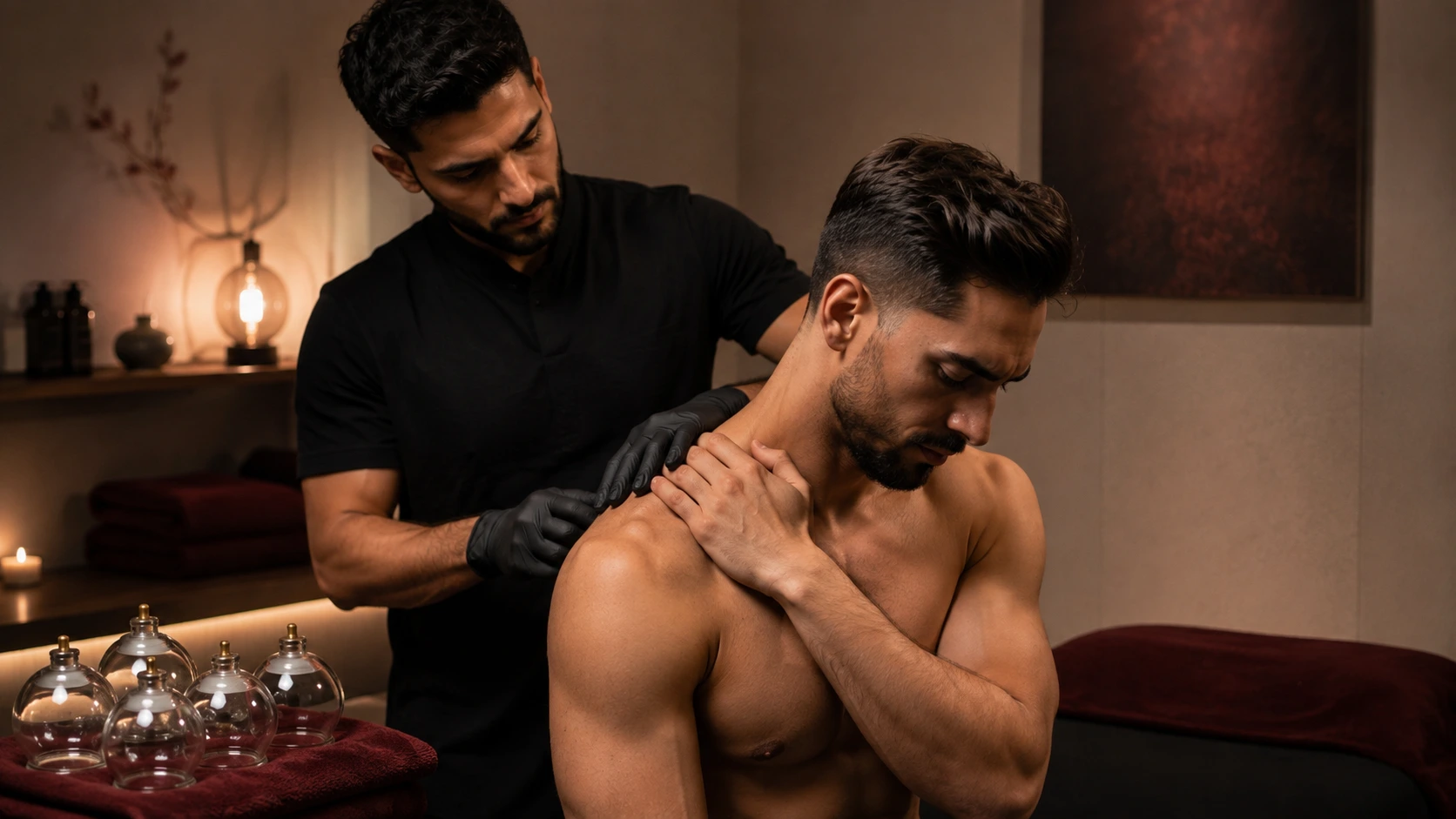
Treatment can then be built around the answer. Hands-on work may be enough. Dry cupping can give a suction-based input without more compression. IASTM may be useful over a smaller stubborn area. The method is secondary to choosing the right target and intensity.
Why treatment relief sometimes disappears quickly
People often judge a treatment by how long the first “loose” feeling lasts. A more realistic way to look at it is whether the session creates a useful window to move better, train more comfortably or change the repeated habits that keep loading the area.
If the next day is ten hours at the same desk, poor sleep and another heavy upper-body session, the shoulder may return to the same protective strategy. That is not a reason to book endless treatment. It is a reason to change the inputs outside the clinic as well.
What you can do without turning your day into rehabilitation
- Change position more often instead of holding one “correct” posture.
- Take brief movement breaks before the shoulders are already extremely tight.
- Vary where screens, keyboard and mouse sit if your setup keeps you rotated.
- Review whether upper-body training volume is outpacing recovery.
- Use comfortable shoulder and upper-back movement rather than forcing painful stretches.
- Pay attention to sleep when the whole body feels heavy and tense.
The aim is not to micromanage every shoulder movement. It is to stop giving the same tissues the same load for hours without variation.
When hands-on treatment makes sense
If the problem behaves like ordinary muscular tightness and you want focused work, a Stress & Body Tension or Muscle Recovery session can be a sensible starting point. The appointment can focus on one main region without requiring you to choose every treatment method in advance.
If you specifically want wet cupping as part of the same appointment, a combined option can include Hijama where suitable.
When shoulder symptoms need proper assessment first
New weakness, loss of power, significant trauma, a shoulder that repeatedly gives way, persistent numbness or tingling, severe night pain, fever, swelling or symptoms that are rapidly worsening should not be treated as a simple “tight shoulder”. Those situations may need medical or physiotherapy assessment.
The same applies when pain is stopping normal function rather than simply making the area feel stiff or loaded.
Common questions
Why do my shoulders rise again after I relax them?
Because deliberately dropping them does not remove the workload or repeated position that made the area feel loaded. Variation, recovery and the rest of your day matter more than repeatedly forcing the shoulders down.
Should I stretch my upper traps every day?
Stretching can feel helpful, but it is not automatically the missing solution. If stretching repeatedly irritates the area or gives only seconds of relief, look at work position, training load and the wider shoulder region as well.
Should I book Hijama or Muscle Recovery for shoulder tension?
If the main goal is direct muscular work, start with Muscle Recovery. If you specifically want wet cupping, choose Hijama or a combined recovery + Hijama option.