Skip to content Skip to footer

Hijama  ·  Wet Cupping  ·  St Albans

Benefits of Hijama

What it may help with, what evidence says, and who it is suitable for

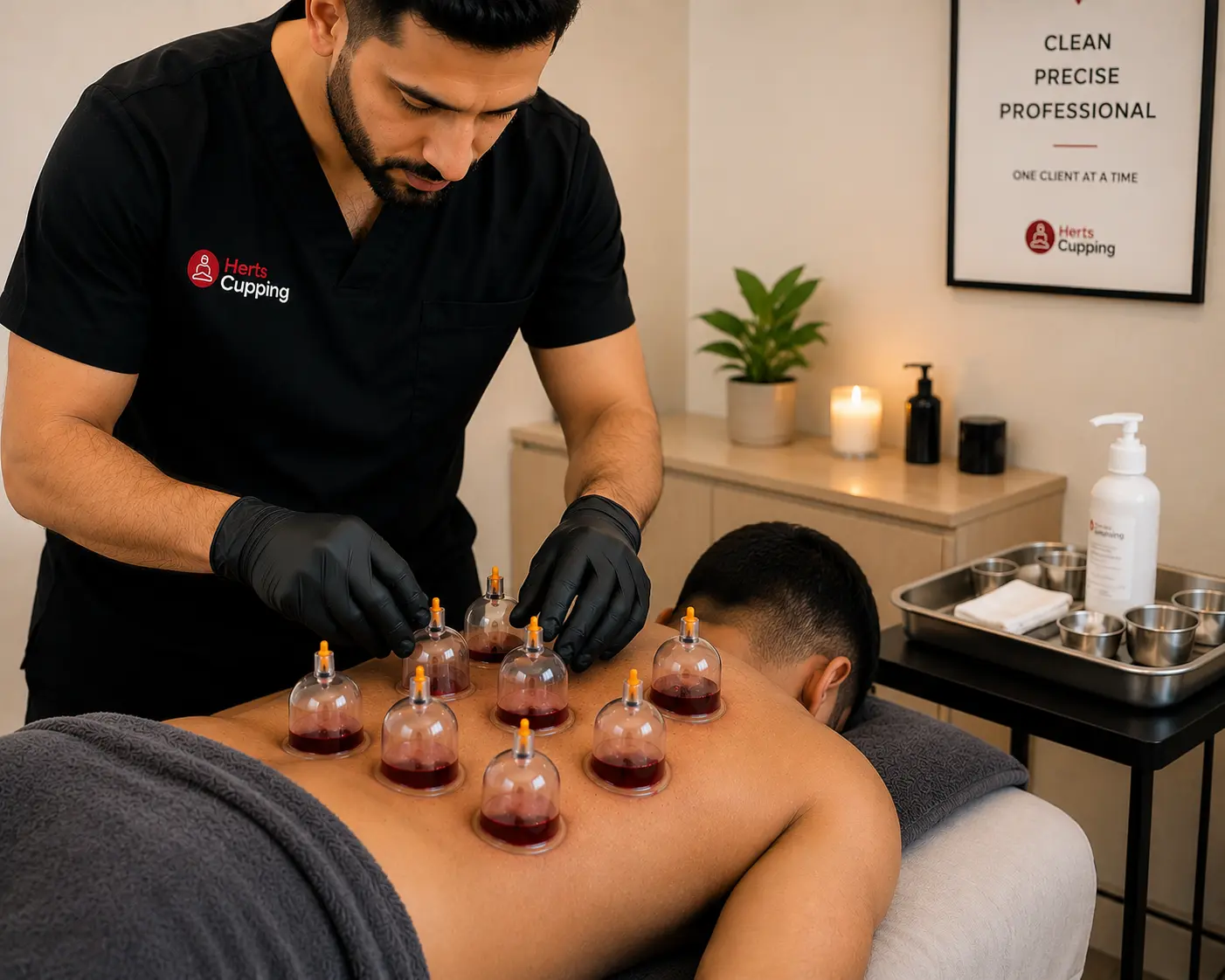
Hijama is a traditional wet cupping therapy where cups create suction on the skin and small superficial scratches allow a small amount of blood to be drawn. People choose it for general wellbeing, muscle tension, recovery, Sunnah practice and that feeling of heaviness that is hard to describe but very familiar. This guide explains what to expect honestly.

Certified practitioner Sterile single-use equipment Private clinic, St Albans

Quick Answer

What Are the Benefits of Hijama?

Featured answer

The main benefits of Hijama that people commonly report include feeling lighter, looser and more relaxed, support with muscle tension, recovery after activity, Sunnah-based wellbeing, and targeted support for areas such as the back, neck, shoulders and legs. Results vary, and Hijama should not be treated as a cure or replacement for medical care.

Written by Abdus Shahid

Certified Hijama practitioner at Herts Cupping, St Albans. This guide has been reviewed for safe claims, suitability guidance and practical aftercare.

Private one-to-one clinic. Sterile single-use equipment. Page updated: May 2026.

About the practitioner

Below is a fuller breakdown of what people commonly report, what evidence says, who it is suitable for and what you should know before booking.

Benefit people search forSafer explanation
Muscle tensionPeople commonly choose Hijama for areas that feel tight, heavy or restricted.
Back and shoulder tightnessHijama can be targeted to common tension areas such as the upper back, shoulders and lower back.
Sports recoverySome active clients use Hijama as part of a wider recovery routine alongside rest, mobility, sleep and training management.
Stress or relaxationSome people report feeling calmer or lighter after treatment, but Hijama is not a treatment for anxiety or depression.
DetoxHijama is traditionally linked with removing stagnant blood, but it should not be described as medically detoxing the body.
Sunnah wellbeingFor Muslim clients, Hijama also has religious and traditional significance as part of a Sunnah-based self-care routine.

What People Report

10 Commonly Reported Benefits of Hijama

These are client-reported experiences and commonly cited reasons people choose Hijama. They are not guaranteed outcomes. Wording is intentionally careful because honesty builds more trust than exaggeration.

1

Hijama for muscle tension and relaxation

Many clients choose Hijama when they feel tight, heavy or restricted. The suction from the cups creates a decompression effect that can help release tissue that manual massage cannot always reach. The most common areas are the upper back, lower back and shoulders.

2

Hijama for back, neck and shoulder tightness

Hijama is commonly chosen for areas where tension keeps returning despite other treatment. Many clients describe a noticeable change in how an area feels immediately after cups are removed. This is not always permanent, but it is often significant enough to be worthwhile.

3

Hijama for sports recovery and active bodies

Active clients often use Hijama as part of a recovery routine. Runners, cricketers, gym-goers and martial artists use it for heavy legs, tight hips, shoulder stiffness and lower back tightness. It can be combined with cupping and massage in the same session for a more complete recovery treatment.

4

Feeling lighter or less heavy after Hijama

This is one of the most consistent client-reported experiences after a session. People often struggle to describe it precisely but use words like lighter, looser, less blocked or less heavy. The feeling can come on the same day or over the following 24 to 48 hours as the area settles.

5

Hijama for relaxation and general wellbeing

Many people feel calmer after a session. This is likely a combination of the physical release, the stillness of the session and the body's response to the treatment. Hijama should not be described as a treatment for anxiety, depression or any diagnosed mental health condition. If you are experiencing those, please speak to your GP.

6

Sunnah benefits of Hijama

For Muslim clients, Hijama carries religious and traditional significance beyond the physical. It is practiced as an act of Sunnah, following the tradition of the Prophet Muhammad ﷺ. Many clients book for this reason alone, independent of any physical complaint. At Herts Cupping, Sunnah Hijama is offered in a private, respectful setting.

7

Body awareness, consultation and aftercare

A proper Hijama session includes a consultation, suitability check and aftercare guidance. Many clients find that the process itself encourages them to pay attention to how their body is feeling, where they hold tension and how they recover. That awareness alone has value.

8

Hijama as part of a recovery routine

Hijama is not a replacement for sleep, movement, hydration or medical care. But it can sit alongside those things as a complementary therapy. Some clients find it particularly useful when they have already done the basics and still feel like something is not quite right.

9

Targeted Hijama for specific areas

Hijama is not one-size-fits-all. The session is tailored to where you are holding tension. Upper back, shoulders, lower back, hamstrings, calves and the base of the skull are all common areas. A brief consultation before the session helps ensure the right areas are prioritised.

10

Hijama vs massage: different method, similar recovery goal

Massage applies pressure downward into tissue. Cupping and Hijama use suction to lift tissue upward. Some people have had lots of massage and still feel stuck. Hijama can reach layers and areas that direct pressure does not. For those people, it is often a meaningful change in how their body responds.

Islamic Tradition

Traditional and Sunnah Benefits of Hijama

For many clients, the traditional and religious context is the primary reason for choosing Hijama. This is not a secondary consideration.

Sunnah practice

Hijama in Islamic Tradition

Hijama has a long and established history in Islamic tradition. The Prophet Muhammad ﷺ encouraged Hijama as a practice and its use is referenced in authentic hadith. Many Muslim clients choose Hijama not only for physical wellbeing, but because the practice itself forms part of a Sunnah-based self-care routine.

The Sunnah dates for Hijama are calculated according to the Islamic (Hijri) calendar, typically on the 17th, 19th or 21st of the lunar month. Many clients book on these dates as a matter of practice and intention.

At Herts Cupping, Sunnah Hijama is offered in a private, one-to-one setting with sterile single-use equipment, full screening and proper aftercare. The environment is respectful and there is no rush. Female-only sessions are available for sisters who require a female practitioner, with limited availability. Ladies are encouraged to WhatsApp first to confirm.

Active Recovery

Hijama for Muscle Tension and Sports Recovery

Many people think of Hijama purely as a traditional or spiritual therapy. It is also used effectively as part of a modern recovery routine.

Active clients often use Hijama for heavy legs, tight shoulders, lower back stiffness, hamstring tightness and areas that feel stuck after training or competition. It is particularly popular with cricketers, runners, combat athletes, lifters and footballers. The pattern is consistent: these clients are not coming for a spiritual session. They are coming because their body feels like it needs a reset and previous treatments have not fully delivered that.

Hijama is not the same as sports massage. Massage uses pressure and manual work. Hijama uses suction, and wet cupping adds the traditional incision element where appropriate. The two can be combined. At Herts Cupping, a Targeted Recovery + Hijama session combines cupping, massage, IASTM and Hijama in a single 60-minute appointment for clients who want the most complete recovery and traditional treatment in one.

For back pain, shoulder problems or any musculoskeletal issue that is severe, worsening, unexplained or related to a known diagnosis, please speak to a physiotherapist or GP before booking. Hijama can support recovery for general tightness and tension, but it is not a replacement for medical assessment.

What Research Says

Evidence: What We Can and Cannot Claim

Being clear about the limits of evidence is more trustworthy than overstating what Hijama can do.

Honest assessment

The Research Is Developing, Not Definitive

Research into cupping and Hijama is still growing. Some studies and reviews discuss potential benefits for pain, muscle tension and recovery. The overall quality of that evidence varies and more high-quality research is needed before any strong medical claims can be made.

Mainstream health summaries generally describe cupping research as limited or preliminary while acknowledging that some people use it for pain, sports recovery and general wellbeing. Side effects can include temporary cupping marks, mild discomfort and, if hygiene protocols are not followed properly, risk of infection.

For these reasons, Hijama at Herts Cupping is presented as a complementary therapy, not a guaranteed medical treatment. What many clients report is real. What research has definitively proven is still limited. Knowing the difference matters.

Sources and further reading

Common Question

Does Hijama Detox the Body?

This is one of the most commonly searched questions about Hijama. Here is an honest answer.

Hijama is often described traditionally as removing stagnant blood or supporting cleansing. That traditional framing has deep roots and is meaningful within Islamic and Chinese medicine frameworks.

In modern health terms, it is better to be careful with the word detox. The body already has organs such as the liver and kidneys that process waste. At Herts Cupping, we explain Hijama as a traditional wet cupping therapy that many people choose for wellbeing, tension and recovery, rather than claiming it medically detoxes the body.

That balanced wording protects trust. It respects the traditional understanding without making a medical claim that the evidence does not support.

Safe Claims

Claims We Are Careful With

This is where many Hijama pages lose trust. We keep the traditional context, but avoid turning it into unsupported medical promises.

ClaimBetter explanation
“Hijama detoxes the body”Hijama is traditionally associated with removing stagnant blood, but the body’s liver and kidneys handle detoxification in the medical sense.
“Hijama treats anxiety or depression”Some people report feeling relaxed, but Hijama is not a treatment for diagnosed mental health conditions.
“Hijama cures pain”Some clients use Hijama for tension or discomfort, but results vary and it should not replace medical assessment where needed.
“Hijama boosts immunity”This should not be claimed as a guaranteed medical effect.
“Hijama treats infertility”Hijama should not be positioned as a fertility treatment or replacement for medical fertility care.

Know the Difference

Hijama vs Dry Cupping vs Massage

All three are available at Herts Cupping. They are not interchangeable.

Traditional Wet Cupping

Hijama

Method: Suction cups + small sterile incisions

Blood drawn: Yes

Tradition: Islamic Sunnah

From: £50 standalone

Best for: Sunnah wellbeing, general recovery, heaviness, religious practice

Suction Only

Dry Cupping

Method: Vacuum cups, no incisions

Blood drawn: No

Tradition: Chinese medicine

From: £35 standalone

Best for: Muscle tightness, combined recovery sessions, first-timers

Manual Therapy

Massage

Method: Hands-on pressure

Blood drawn: No

Tradition: Various

From: Part of £75 Recovery

Best for: General tightness, relaxation, combined recovery sessions

Not sure which to choose? WhatsApp us and we will help you decide based on what you are dealing with.

Suitability

Who Is Hijama Suitable For and Who Should Avoid It

A safety section this clear is not just a disclaimer. It means you can trust the rest of the page.

Hijama is generally suitable for

  • Adults in general good health seeking wellbeing and recovery support
  • Muslim clients seeking Sunnah Hijama in a private setting
  • People with general muscle tension, back, neck or shoulder tightness
  • Active clients looking to support recovery between training sessions
  • People who have tried massage but want a different approach
  • People who feel generally heavy, sluggish or restricted
  • Those who have discussed Hijama with their GP and have no contraindications

Hijama may not be suitable for

  • People taking blood-thinning medication (warfarin, aspirin, etc.)
  • People with bleeding disorders or blood clotting conditions
  • People with severe or uncontrolled anaemia
  • Active infection, fever or open wounds in or near the treatment area
  • Certain skin conditions in or near the treatment area
  • Pregnancy, unless assessed by a suitably trained practitioner
  • People who faint easily or have a very low blood pressure
  • People recovering from recent surgery
  • Anyone with uncontrolled diabetes or other uncontrolled chronic conditions
  • Children under 18 without parental consent and appropriate assessment

If you are unsure whether Hijama is suitable for you, speak to your GP before booking. If you have a question, WhatsApp us and we will give you an honest answer before you commit to an appointment.

What to Expect

What Happens During a Hijama Session

Step by step, from arrival to aftercare. Most clients are surprised by how straightforward the process is.

1

Consultation and suitability check

A brief conversation about your health, the areas you want to address and whether Hijama is appropriate for you today. This is not just paperwork. It shapes the session.

2

Area selection and skin preparation

The treatment areas are selected based on your consultation. The skin is cleaned and prepared using appropriate antiseptic. You will be positioned comfortably before the session begins.

3

Dry cups applied first

Sterile cups are applied to the skin to create suction. This decompresses the tissue and draws blood flow to the surface. The sensation is a tight pulling or stretching feeling. Cup pressure is adjusted throughout.

4

Small superficial scratches

Using sterile single-use lancets, small superficial scratches are made on the skin within the cupped area. These are shallow and quick. Most people find this less uncomfortable than they expected.

5

Cups reapplied

The cups are reapplied over the scratched area. The suction draws a small amount of blood into the cup. The amount drawn is small and the process is controlled throughout.

6

Cups removed, area cleaned

The cups are removed and the treated areas are cleaned thoroughly. All single-use equipment is disposed of immediately. The area is dressed where appropriate.

7

Brief rest

You will have a few minutes to rest before getting up. This is not optional – it is part of the session. Standing up slowly and taking your time is important, particularly after a first session.

8

Aftercare explained

Clear aftercare guidance before you leave. What to avoid, what to eat and drink, when to expect marks to fade and when to get in touch if anything does not feel right.

Recovery

What to Expect After Hijama

The first 24 to 48 hours after Hijama matter. Here is what is normal and what to do.

What is normal

  • Circular marks (cupping marks) on treated areas
  • Mild tenderness around the treated areas
  • Feeling tired or sleepy, especially after a first session
  • Feeling lighter, looser or more relaxed
  • Occasional mild headache, usually if not well hydrated
  • Marks fading over 2 to 7 days

What to do and avoid

  • Drink plenty of water and rest where possible
  • Eat normally – a light meal is fine
  • Avoid cold water on treated areas for 24 hours
  • Avoid cold draughts, air conditioning directly on the skin
  • Avoid heavy exercise for 24 to 48 hours
  • Avoid alcohol and smoking for at least 24 hours

How soon do you feel the benefits?

  • Some feel lighter or more relaxed the same day
  • Others feel tired first, then notice the change after 24-48 hours
  • The response varies by individual and area treated
  • Hydration, sleep and training load all affect the outcome

How long do the benefits last?

  • It varies by person, area treated and general health
  • Some book occasionally for Sunnah practice or wellbeing
  • Others return when tightness or heaviness builds up again
  • We do not recommend unnecessary frequent Hijama

When to get in touch

  • If marks are unusually painful or not fading after 10 days
  • If the treated area shows signs of infection
  • If you feel unwell beyond the normal tiredness
  • WhatsApp us any time – we respond to aftercare questions

FAQs

Frequently Asked Questions About Hijama

The commonly reported benefits include feeling lighter and less tense, support with muscle tension and recovery, Sunnah-based wellbeing and a general sense of relaxation. Results vary from person to person and Hijama should not be described as a cure for specific medical conditions.

Many people choose Hijama specifically for back tightness. It is commonly used for the upper back, lower back and shoulders. It is not a treatment for diagnosed medical conditions. If your back pain is severe, worsening, unexplained or related to a known injury, speak to a GP or physiotherapist first.

Many clients choose Hijama for upper back, neck and shoulder tightness, especially when the area feels heavy or restricted. It may support relaxation and recovery, but persistent or worsening pain should be checked by a qualified medical professional.

Active clients often include Hijama as part of a recovery routine. It is used for heavy legs, tight shoulders, lower back stiffness and post-training heaviness. At Herts Cupping, Hijama can be combined with cupping and massage in the same session. View sports recovery sessions.

Some people feel calmer after a session. Hijama should not be described as a treatment for anxiety, depression or any diagnosed mental health condition. If you are experiencing those difficulties, please speak to your GP or a qualified professional.

In traditional practice, Hijama is described as removing stagnant blood and supporting the body's natural processes. In modern health terms, we prefer to present Hijama as a complementary therapy that may support recovery and wellbeing, rather than claiming it medically detoxes the body. The body's own organs handle waste processing.

Yes. Hijama is referenced in authentic Islamic tradition and was practiced and encouraged by the Prophet Muhammad ﷺ. Many Muslim clients choose Hijama as part of a Sunnah self-care routine, often on the traditional Sunnah dates according to the Islamic calendar.

Most people describe a pulling or tight sensation rather than pain. The initial suction can feel strong on tense areas. The small superficial scratches are usually quick and mild. Most clients say it is more manageable than they expected. Cup pressure can be adjusted throughout.

A small amount of blood is drawn into the cups following the superficial scratches. The colour and consistency varies. In traditional Hijama, darker blood is sometimes associated with areas of congestion. Sterile single-use lancets and cups are used throughout and disposed of after each session.

Yes. Circular marks are a common result of cupping and indicate increased blood flow to the area. They are not bruises in the traditional sense, are usually painless, and fade within 2 to 7 days depending on the individual and how much tension was present.

Usually 2 to 7 days, though this varies by individual, skin type and the areas treated. Staying hydrated and avoiding heat or heavy activity in the 24 hours after treatment helps the area settle more comfortably.

Some people feel lighter or more relaxed the same day. Others feel tired first and notice the difference after 24 to 48 hours. The response depends on the person, treated area, hydration, sleep, training load and general health.

It varies. Some people book occasionally for general wellbeing or Sunnah practice. Others return when a specific area starts to feel tight or heavy again. We do not recommend unnecessary frequent Hijama. If one session is enough, we will tell you.

Hijama may not be suitable for people taking blood-thinning medication, those with bleeding disorders, severe anaemia, active infection, certain skin conditions, fever, pregnancy (unless appropriately assessed), people who faint easily or those with uncontrolled chronic conditions. If unsure, speak to your GP first or WhatsApp us.

Eat a light meal 2 to 3 hours before your session. Stay well hydrated. Avoid intense exercise on the day of treatment. Arrive in comfortable, loose clothing. Do not arrive on an empty stomach or immediately after a heavy meal.

For the first 24 to 48 hours: avoid cold water on the treated areas, direct cold air, heavy exercise, alcohol and smoking. Rest is encouraged. Stay hydrated and eat normally.

There is no single answer. Some clients book for Sunnah occasions every few months. Others book when a specific area feels tight or heavy. We do not recommend unnecessary frequent sessions. If one session is enough, we will tell you.

Not exactly. Cupping is a broad term that includes dry cupping (suction only) and fire cupping (glass cups with heat). Hijama specifically refers to wet cupping, where small superficial scratches allow blood to be drawn. All are available at Herts Cupping.

They are different, not better or worse. Hijama involves small superficial scratches and is chosen for Sunnah practice and traditional wellbeing. Dry cupping uses suction only without incisions and is commonly used within combined massage and recovery sessions. A consultation helps determine the right approach.

Abdus Shahid

Certified Hijama Practitioner  ·  Herts Cupping, St Albans

Abdus Shahid is the lead practitioner at Herts Cupping, a private Hijama and recovery therapy clinic in St Albans, Hertfordshire. Trained and certified in Hijama wet cupping, dry cupping, massage and IASTM, he has worked with clients ranging from those seeking Sunnah-based self-care to professional athletes and regular gym-goers. All Hijama sessions at Herts Cupping use sterile single-use equipment in a clean, private, one-to-one clinic environment. The clinic is open 7 days a week.

Page last reviewed: May 2026. Content reviewed for accuracy, compliance language and safety guidance by the Herts Cupping practitioner team.

Safety note: The information on this page is for general educational purposes and is not a substitute for medical advice. Hijama and cupping therapy should only be carried out by a trained practitioner using sterile single-use equipment. If you have a medical condition, take prescribed medication or are unsure whether Hijama is appropriate for you, speak to your GP before booking. Herts Cupping is not a medical diagnosis or treatment service.

Ready to Book Your First Hijama Session?

Private one-to-one clinic in St Albans. Certified practitioner. Sterile single-use equipment. Open 7 days a week.